Parmelin succession: The SVP wants the asylum portfolio, but the Federal Council will decide
The Swiss People's Party (SVP) wants Guy Parmelin's successor to take over the asylum portfolio. But it is the Federal Council that decides on the departments. The road to the justice department runs through Beat Jans.
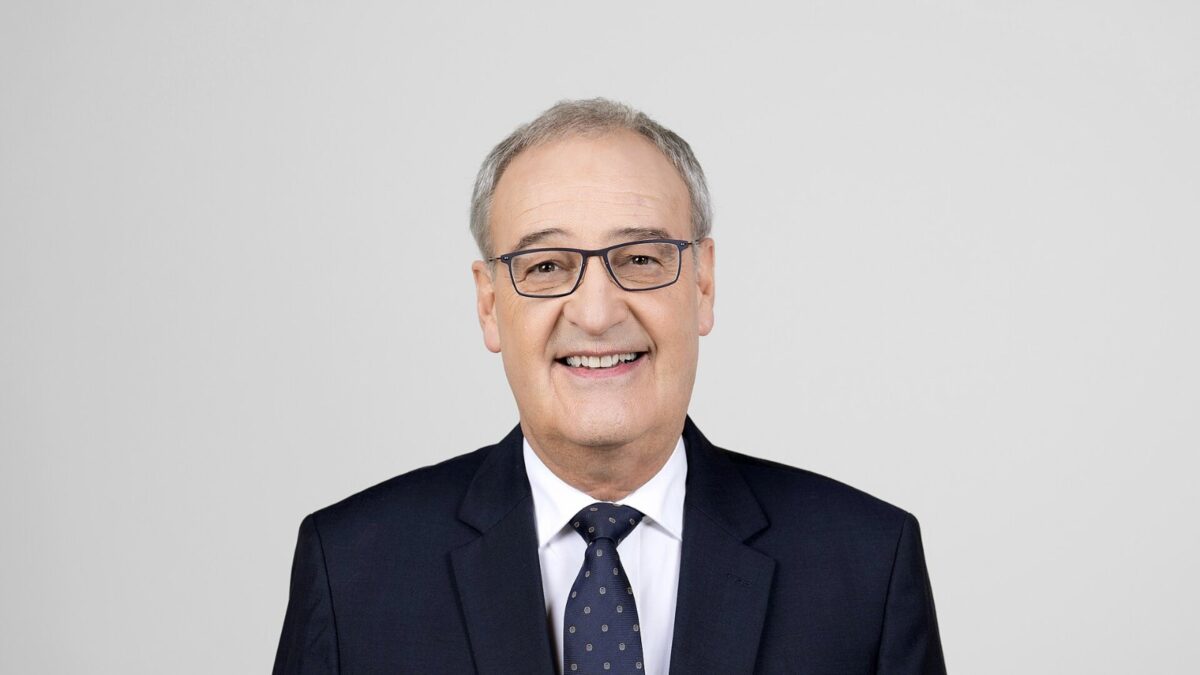
The Swiss People’s Party (SVP) is assured of the seat, but not of the department. On Oct. 2, 2026, Guy Parmelin, President of the Swiss Confederation, announced his resignation effective Dec. 31, 2026, after 11 years in the national government. On Dec. 9, 2026, the United Federal Assembly (joint session of both chambers) will elect his successor. That the seat will go to the SVP is hardly in dispute. “The SVP’s seat is undisputed,” read SRF’s announcement of its “Arena” broadcast of Oct. 16, 2026. What remains open is which role the new member will take on in the government.
The SVP staked out its position early. The Federal Department of Justice and Police (FDJP) and the defense department (DDPS) were the departments “with the greatest problems for the future and the greatest leadership deficit,” the party wrote on the day the resignation was announced. In filling Parmelin’s seat, it said, it would pay particular attention to ensuring that the new member could lead one of these departments. But neither the SVP nor parliament decides on the departments; the Federal Council itself does. What falls vacant for now is the economic affairs department (EAER). The SVP will get the FDJP only if Justice Minister Beat Jans of the Social Democrats (SP) leaves it.
| Item | Status | Source |
|---|---|---|
| Resignation | Announced Oct. 2, 2026, effective Dec. 31, 2026 | SVP, AWP |
| Election | Dec. 9, 2026, by the United Federal Assembly | Parliamentary Services |
| Candidacies | Eight submitted by Oct. 23, 2026, none withdrawn; Thomas Aeschi had not confirmed his candidacy as of Oct. 29, 2026 | SVP, SRF, 20 Minuten |
| Nomination | Hearings until Nov. 13, 2026, then proposal by the selection committee; parliamentary group decision on Nov. 20, 2026 | SVP, 20 Minuten |
| Departments | Allocated by the full Federal Council, usually by seniority | Parliamentary Services, SRF |
| Falling vacant | The EAER; no move by Beat Jans or Martin Pfister has been decided | SRF, Blick |
| Term of office | Until the general election of the Federal Council in December 2027 | Parliamentary Services |
| Balance of power | SVP at 29.9% in the SRG SSR election barometer of Oct. 16, 2026 (September 2026 survey) | Sotomo, AWP |
Eleven years, two departments
Guy Parmelin was elected on Dec. 9, 2015, to succeed Eveline Widmer-Schlumpf. He received 138 votes in the third round; the absolute majority was 119. He prevailed over the two other names on the official SVP ticket: Thomas Aeschi received 88 votes, and Norman Gobbi of Ticino 11. Parmelin headed the DDPS from January 2016 to December 2018 and has led the EAER since January 2019. He was President of the Swiss Confederation in 2021 and 2026.
According to the news agency AWP, the 66-year-old from the canton of Vaud explained his resignation by saying that he wanted to make way for new blood in uncertain times. The decision had nothing to do with his health, he said; he had been weighing it since the summer. “My feu sacré was perhaps no longer quite as sacré as it was at the beginning,” he told reporters in Bern. And: “No one is irreplaceable.”
How the SVP selects its candidates
The SVP has had the procedure in place for some time. Following the 2019 elections, it set up a selection committee chaired by former National Council member Caspar Baader. When a seat on the Federal Council falls vacant, the committee runs the selection process up to the nomination by the parliamentary group. The cantonal parties had until noon on Friday, Oct. 23, 2026, to submit their candidates.
The committee is holding hearings with all the candidates, according to 20 Minuten at undisclosed locations until Nov. 13, 2026. It examines their positions on the party’s core issues: armed neutrality and self-determination, the EU treaty package, asylum and migration, the army and internal security, relief for the middle class and businesses, and a secure and affordable energy supply. Leadership experience also counts, “particularly with regard to the problem departments, the FDJP and the DDPS,” as the SVP wrote on Oct. 23, 2026. The committee is to submit its proposal to the parliamentary group’s executive committee by Nov. 13, 2026. On Nov. 20, 2026, the parliamentary group will decide on its slate of nominees.
How many names will be on the ticket is still open. According to Baader, the selection committee intends to decide this only after all the hearings; it will then also consider whether it needs to approach other prominent party figures. SRF and Blick report two or three names; according to Radio SRF, parliamentary group leader Thomas Aeschi is pushing for at least two. For the succession to Ueli Maurer in 2022, the parliamentary group’s executive committee had recommended a two-person ticket.
The party has taken precautions against an election outside the ticket. Under Article 9 of the party’s bylaws, anyone who accepts the office of Federal Councillor without having been nominated by the parliamentary group automatically loses SVP membership. According to 20 Minuten, the candidates also sign a personal declaration that they will not accept such an election. The Federal Assembly itself is not bound by any ticket. The party wrote the rule into its bylaws after the 2007 Federal Council election: at the time, the Federal Assembly voted Christoph Blocher out of office and elected in his place Eveline Widmer-Schlumpf, who, though an SVP member, had not been an official candidate. The SVP did not recognize her as its representative, and the conflict ultimately led to the founding of the Conservative Democratic Party (BDP). Political scientist Oscar Mazzoleni told RSI that the SVP was the only party that could not accept a rogue candidacy outside the ticket.
Eight candidacies, few commitments
By the deadline, the cantonal parties had put forward eight names: five from German-speaking Switzerland, two from French-speaking Switzerland and one from Italian-speaking Ticino; seven men and one woman. Four sit in the National Council, one in the Council of States and three in a cantonal government. One name comes with a caveat. The SVP of the canton of Zug nominated parliamentary group leader Thomas Aeschi as a precaution; his personal decision was still pending on Oct. 23, 2026. “Now I want to take time to reflect and hold the necessary talks,” he told SRF. According to 20 Minuten, his decision was still open on Oct. 29, 2026; he will be heard nonetheless, as committee chairman Baader confirmed. He has recused himself from the selection committee until the election. No one had withdrawn as of Oct. 29, 2026.
Those who have declined include party president Marcel Dettling (“My job is to lead the party”), Council of States member Esther Friedli, National Council member Pascal Schmid, the party’s head of asylum policy, and Thomas Matter and Natalie Rickli of Zurich. The most populous canton is not represented in the field. According to SRF, Zurich has not had a member on the Federal Council for four years; the last Federal Councillor from Zurich was Ueli Maurer.
| Name | Canton | Current office | Statement on the department question |
|---|---|---|---|
| Thomas Aeschi | ZG | National Council member, parliamentary group leader | Candidacy not confirmed as of Oct. 29, 2026 |
| Céline Amaudruz | GE | National Council member | “I am running for the Federal Council, not for a particular department”; she has preferences, but it is too early to talk about them (AWP) |
| Marco Chiesa | TI | Council of States member | No statement found |
| Jean-Pierre Gallati | AG | Cantonal government member, health and social affairs including asylum | No statement found |
| Michael Graber | VS | National Council member | As a lawyer, he would be most at home in the justice department, but he would take on any portfolio (according to Blick and blue News) |
| Franz Ruppen | VS | Cantonal government member | “You have to take on whatever the Federal Council as a body then decides.” As a lawyer, he would be most at home in the justice department (according to Blick) |
| Pierre Alain Schnegg | BE | President of the cantonal government; health, social affairs, integration | No statement found |
| Rémy Wyssmann | SO | National Council member | “I am capable of taking on any department”; according to blue News, sees himself as best suited to the FDJP |
On the core issues, the field is closely aligned. Mazzoleni sees hardly any differences in positions, notably on Europe and migration, but he does see differences in style. In the sources reviewed, Amaudruz, Chiesa, Graber and Wyssmann, among others, have come out against the EU treaty package. “Switzerland’s independence and sovereignty are at stake,” Amaudruz said of the treaties, according to SRF; as a Federal Councillor, however, she would represent the position of the Federal Council as a body. At the delegates’ assembly of Oct. 17, 2026, Graber spoke of a “colonial treaty,” while Wyssmann says: “The EU treaties endanger our institutions.” There are individual departures from the party line: Amaudruz has voted differently from the parliamentary group on social issues on several occasions, and Gallati has publicly criticized the neutrality initiative. On asylum, Gallati takes a hard line, according to blue News, and so does Schnegg, in SRF’s assessment.
Who allocates the departments
The rule is unambiguous. In their fact sheet on Federal Council elections, the Parliamentary Services state that allocating the departments is a matter not for parliament but for the Federal Council as a whole. Members of the Federal Council, they add, are obliged to take on the department assigned to them by the full Federal Council. As the legal basis, the Parliamentary Services cite Article 35 of the Government and Administration Organisation Act. The SVP leadership, too, acknowledges where the responsibility lies. “Moreover, the allocation of departments is a task for the Federal Council,” Aeschi said in an interview with Blick.
In practice, length of service counts. Members state their preferences in order of seniority. “The basic principle in the Federal Council room is: the longest-serving members can choose their department,” SRF writes. If Beat Jans and Martin Pfister could not agree, there would have to be a vote, according to SRF, which happens very rarely. From 2027, the order will be as follows: Ignazio Cassis (FDP.The Liberals, elected 2017), Karin Keller-Sutter (FDP, 2018), Albert Rösti (SVP) and Elisabeth Baume-Schneider (SP, both 2022), Beat Jans (SP, 2023), Martin Pfister (The Centre, 2025) and, last, the new SVP member.
This essentially leaves three scenarios. If no one moves, the new member takes over the EAER. If Jans moves to the EAER, the FDJP falls vacant; Pfister can then choose first between the DDPS and the FDJP, and the new member gets the remaining department. If Pfister moves to the EAER, the new member is left with the DDPS. In theory, more senior members could also claim the EAER, but so far the media have named only Jans and Pfister.
| Scenario | What falls vacant | The new member gets |
|---|---|---|
| No one moves | EAER | EAER |
| Beat Jans moves to the EAER | FDJP | FDJP or DDPS, depending on Martin Pfister’s choice |
| Martin Pfister moves to the EAER | DDPS | DDPS |
The past shows how newcomers fare. After the elections of Dec. 5, 2018, Karin Keller-Sutter took over the FDJP and Viola Amherd the DDPS, while Parmelin moved to the EAER. “The two newcomers more or less had to take what was left,” political scientist Georg Lutz of the University of Lausanne said at the time. In December 2023, Elisabeth Baume-Schneider received the vacated Federal Department of Home Affairs, and the newly elected Beat Jans became justice minister. “The FDJP is currently the least popular department in Bern,” commented SRF federal politics correspondent Christa Gall.
What is at stake at the justice department
By its own account, the FDJP deals with issues in the areas of law, society, migration, security and prevention. It comprises the State Secretariat for Migration (SEM), the Federal Office of Justice and the Federal Office of Police (fedpol), as well as institutes such as the Swiss Federal Institute of Intellectual Property, several commissions and the Post and Telecommunications Surveillance Service.
Politically, the asylum portfolio takes center stage. The number of new asylum applications fell to 27,740 in 2024, 8.2% fewer than the year before. In 2025, it declined for the second year in a row, to 25,781 (down 7.1%). Since Sept. 17, 2026, the SEM has been projecting around 22,000 applications for 2026 in its most likely scenario; at the start of the year, the figure was still 25,000. From January to September 2026, the SEM registered 15,667 asylum applications, 17% fewer than in the same period a year earlier. On top of that come people from Ukraine seeking protection. In 2025, 12,897 applications for protection status S were filed, after 16,616 the previous year. At the end of 2025, 71,762 people held this status, 3,692 more than a year earlier. For 2026, the SEM now expects only around 10,000 applications for status S, compared with 12,000 at the start of the year. On Aug. 19, 2026, the Federal Council decided not to lift status S before March 4, 2028, as a lasting stabilization of the situation in Ukraine was not in sight. Since Aug. 20, 2026, the status has been granted only to people who comply with any military obligations they may have in Ukraine; existing cases are not affected.
The department is considered unpopular. “The justice department is generally regarded as unpopular, as a ‘beginner’s department,'” writes SRF federal politics correspondent Andy Müller.
The SVP’s arguments
The SVP bases its claim on the state of the department. Its strength gives it backing: in the election barometer, it polls 29.9%, while the FDJP has been headed since 2024 by Beat Jans of the SP. At the delegates’ assembly in Bulle on Oct. 17, 2026, party president Marcel Dettling attacked the justice minister directly: “SP Federal Councillor Jans had better do his job on the asylum portfolio.” And: “Nearly 40 requests for tougher rules are now sitting on his desk.” The press release on the assembly stated: “Because Justice Minister Jans is doing nothing, the people have to lay down the law.” Campaign manager Manuel Strupler called out to the delegates: “More Rösti instead of more Jans.”
The conflict predates the vacancy. According to Blick, the two SVP Federal Councillors were already applying pressure behind the scenes in the spring of 2025: in the interdepartmental consultation, Albert Rösti called for an “asylum turnaround,” and Parmelin saw an “immediate need for action.” With cantonal government member André Rüegsegger, a former attorney, the SVP of the canton of Schwyz explicitly wanted to open the way to the FDJP, as AWP reported. Rüegsegger has since declined. Several of those put forward name the justice department as the obvious choice. As lawyers, Graber and Ruppen would be most at home there, but ultimately one has to take on whatever the Federal Council decides, Blick writes. According to blue News, Wyssmann considers himself best suited to the FDJP but lays no claim to any particular department.
In short, the proponents’ argument runs as follows: whoever makes asylum policy a central issue should also take responsibility for it. The SVP could test its prescriptions but would also have to be judged by results.
The objections: reshuffle, economic affairs department, collegiality
The first objection is practical. The FDJP will become vacant only if Beat Jans moves. On Oct. 4, 2026, under the headline “Beat Jans eyes the EAER,” Blick reported that Jans might want to move to the economic affairs department; the report contains no statement from Jans or his department. Bern political scientist Adrian Vatter nevertheless considers a move plausible: “The most likely scenario would be for Beat Jans to move to the economic affairs department,” he told SRF.
This shifts the dispute to the EAER. “That would indeed be an exceptional situation, because we have never had anyone from the political left in the economic affairs department,” Vatter said. According to Vatter, the center-right parties want to prevent a left-winger from putting a distinctive stamp on housing or labor market policy. The president of the business federation Economiesuisse stressed, according to SRF, that it was important for the economic affairs department to remain in center-right hands. FDP co-president Benjamin Mühlemann also spoke out against a move by Jans to the EAER in comments to the Tamedia newspapers, according to SRF. “Except that the two center-right parties also dread the prospect of Jans as economics minister,” SRF editor Andy Müller wrote. The alternative would be for Martin Pfister to move to the EAER. “The center-right parties and associations would support that,” Vatter said, but added: “That would then also require a political majority decision in the Federal Council, which is not always welcome.” Pfister took office at the DDPS only a year and a half ago, “with the aim of staying,” SRF writes. On Oct. 10, 2026, 20 Minuten, citing CH Media, reported that a move by Pfister was being discussed in parts of his party and among people close to him. Centre party president Philipp Matthias Bregy called this discussion “inappropriate at the parliamentary level.” No statements by Jans or Pfister were found in the sources reviewed up to Oct. 30, 2026.
The second objection is more fundamental. Departments are allocated according to collegiality and seniority, not party wishes. According to Blick, there are “also tactical considerations” behind the SVP’s willingness to let Jans move to the EAER: Jans would then have to battle the farmers and defend the EU dossier. Candidates, too, stress that they are not tying themselves to a department. “I am running for the Federal Council, not for a particular department,” Céline Amaudruz said when she launched her candidacy. Then there is the short time frame: the person elected will serve until the general election of the Federal Council in December 2027, that is, for one year to begin with.
The other parties have mostly made statements of principle. Raising the question of whether a new SVP member should take charge of asylum was legitimate, SP co-president Cédric Wermuth said, according to 20 Minuten of Oct. 3, 2026: “But that remains a matter for the Federal Council.” In a survey by “Schweiz heute” on what is required of the SVP candidates, published by the Bote der Urschweiz on Oct. 24, 2026, none of the parliamentary groups surveyed named a specific department. The Centre parliamentary group wants to know from the candidates “whether they will support and defend a Federal Council decision even if it does not reflect their own party line.”
French-speaking Switzerland, Ticino, women: the second debate
Alongside the question of departments, a second debate is under way. Article 175 of the Federal Constitution requires that the election take into account the need for the country’s geographical and language regions to be appropriately represented. Since the popular vote of Feb. 7, 1999, this provision has replaced the former cantonal clause. Today, French- and Italian-speaking Switzerland provides three of the seven members: Parmelin, Baume-Schneider and Cassis. If Parmelin is not succeeded by someone from French-speaking Switzerland, Baume-Schneider would be the region’s only representative on the Federal Council from 2027. French-speaking Switzerland accounts for 25% of the population and therefore, as a rule, holds two of the seven seats on the Federal Council, the broadcaster La Télé wrote on Oct. 16, 2026.
Historically, this would not be unprecedented. According to SRF, on at least four occasions since 1848, only one member from French-speaking Switzerland and one from Ticino sat on the Federal Council, most recently in the 1960s with Roger Bonvin and Nello Celio. Federal Councillor Baume-Schneider warned on Radio SRF’s “Samstagsrundschau” on Oct. 17, 2026: “Representation of the language regions is very important for French-speaking Switzerland.” And: “It is about the cohesion of Switzerland.” The demand is present within the SVP itself as well. “A woman or a man from French-speaking Switzerland must be on the ticket,” Amaudruz said, according to AWP. The FDP parliamentary group expects “that the SVP will also consider personalities from French- and Italian-speaking Switzerland when putting together its ticket,” parliamentary group leader Damien Cottier stated in the same survey of Oct. 24, 2026.
Others put this into perspective. “For one thing, the SVP is simply less firmly rooted in French-speaking Switzerland,” Michael Hermann, head of the research institute Sotomo, told Blick in July. “Cantonal representation on the Federal Council is increasingly receding into the background.”
The third question concerns women. “Today, only two of the seven members of the Federal Council are women,” SRF notes. The women’s umbrella organization Alliance F called on the SVP to put forward an all-female ticket. According to Blick, a woman’s name has appeared on an SVP ticket only once before: that of Zurich cantonal government member Rita Fuhrer in 2000. Amaudruz would be the first woman the SVP gets elected to the Federal Council as an official candidate. “If Switzerland’s largest party nominated neither a woman nor anyone from French-speaking Switzerland for the Federal Council, it would have to justify that,” commented SRF federal politics correspondent Andreas Stüdli.
| If elected | French | Italian | German | Women | Canton represented twice |
|---|---|---|---|---|---|
| Céline Amaudruz (GE) | 2 | 1 | 4 | 3 | No |
| Pierre Alain Schnegg (BE) | 2 | 1 | 4 | 2 | Bern (with Rösti) |
| Marco Chiesa (TI) | 1 | 2 | 4 | 2 | Ticino (with Cassis) |
| Thomas Aeschi (ZG) | 1 | 1 | 5 | 2 | Zug (with Pfister) |
| Gallati, Graber, Ruppen or Wyssmann | 1 | 1 | 5 | 2 | No |
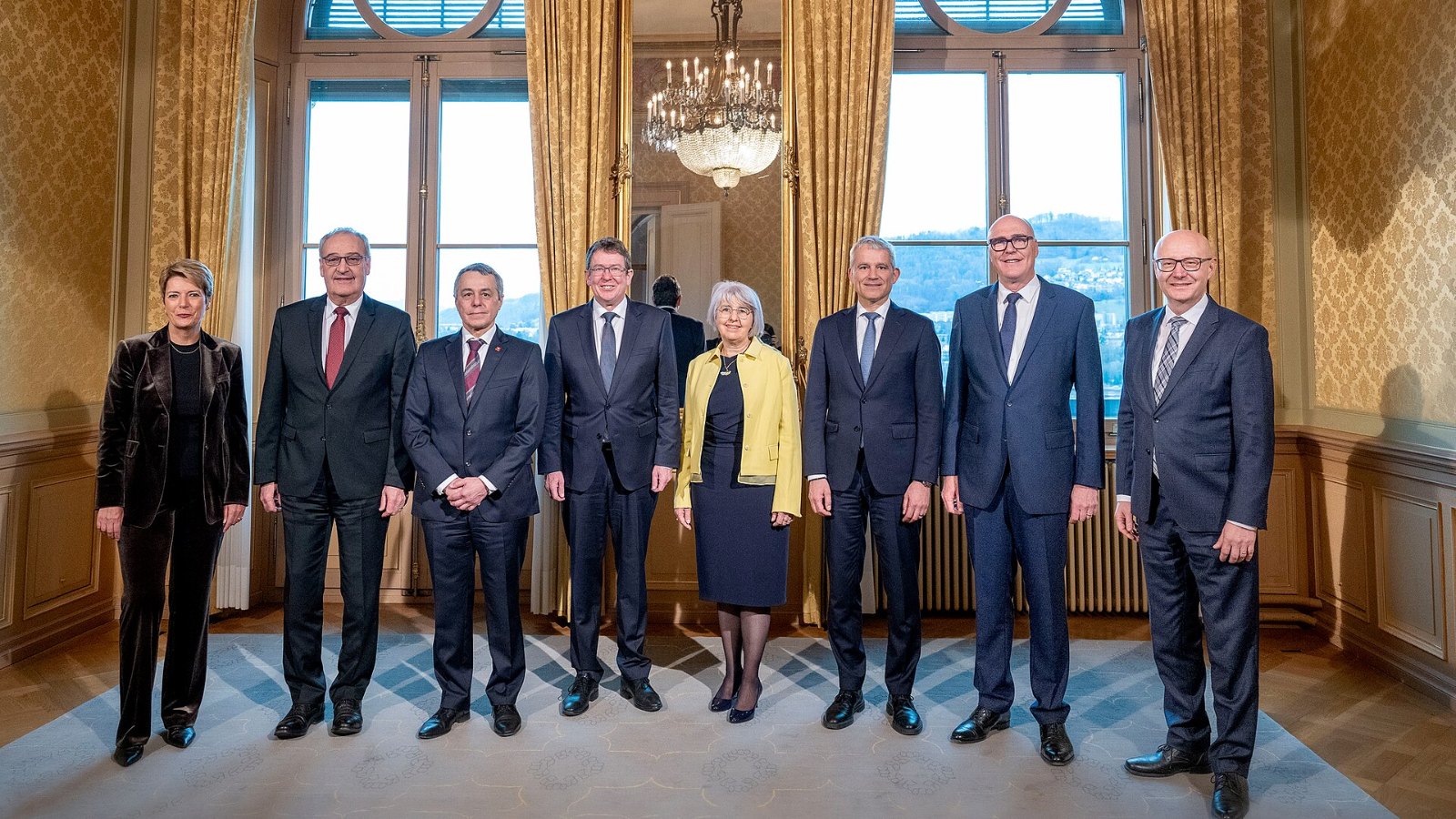
The Parmelin succession and the 2027 elections
The by-election is also a prelude. The person elected will serve until the end of the current legislative term; the National Council elections will take place in October 2027, and the general election of the Federal Council in December 2027. In the election barometer of SRG SSR (Swiss Broadcasting Corporation), for which Sotomo surveyed 25,092 eligible voters online from Sept. 10 to Sept. 23, 2026, the SVP stands at 29.9%, two percentage points more than in the 2023 elections. The SP gains, rising to 19.3%. The FDP (13.3%) and the Centre (12.6%) lose ground, the Greens reach 10.3% and the Green Liberals (GLP) 7.1%. The margin of error is plus or minus 1.2 percentage points.
For the magic formula, the convention for sharing out the seven Federal Council seats among the largest parties, third place is the delicate one. The gap between the FDP and the Centre is within the margin of error. According to an SRF analysis after the 2023 elections, a little over 14% of the vote is considered the benchmark for a seat on the Federal Council. “There could be a neck-and-neck race for third place,” Michael Hermann said as early as October 2025. FDP parliamentary group leader Damien Cottier brushed this aside at the time: “The discussion must take place after the elections. But as things stand, it remains a poll.” Centre parliamentary group leader Yvonne Bürgin countered: “The 2027 elections will be decisive.”
How the election on Dec. 9, 2026, will proceed
Anyone named on more than half of the valid ballots is elected; blank and invalid ballots do not count, and voting is secret. In the first two rounds, anyone eligible can receive votes; no prior candidacy is required. From the third round on, no new candidates are admitted. From the second round on, anyone who receives fewer than 10 votes is eliminated. If everyone has at least 10 votes, then from the third round on, the person with the fewest votes is eliminated, unless several people share that number. The Parliament Act no longer provides for drawing lots: in the event of a tie, voting continues until one person reaches an absolute majority. The person elected declares whether he or she accepts the election. In a by-election, the person elected takes office no later than two months after the election. Since Parmelin’s resignation takes effect on Dec. 31, 2026, the new member is likely to start on Jan. 1, 2027.
The most recent Federal Council elections show that even elections with an official ticket can take several rounds. Beat Jans was elected in the third round with 134 votes at the general election of the Federal Council on Dec. 13, 2023. In the by-election of March 12, 2025, Martin Pfister missed the absolute majority of 123 votes in the first round by a single vote, with 122, and was elected in the second round with 134 votes.
Timeline of the Parmelin succession
Arena: Should the SVP take over the Federal Department of Justice and Police?
For: Yes, those who criticize should deliver
- The SVP calls the FDJP and the DDPS the departments “with the greatest problems for the future and the greatest leadership deficit” (SVP, Oct. 2, 2026).
- Asylum and migration are among the core issues on which the selection committee is vetting the candidates (SVP, Oct. 23, 2026).
- The SVP is the strongest party, polling 29.9% in the SRG SSR election barometer of Oct. 16, 2026; the FDJP has been headed since 2024 by Beat Jans of the SP (Sotomo, SRF).
- According to the party leadership, nearly 40 requests for tougher rules are pending with the justice minister (Dettling speech, Oct. 17, 2026).
- Several candidates name the justice department as the obvious choice (Blick, blue News).
- Political scientist Adrian Vatter considers a move by Beat Jans to the EAER the most likely scenario (SRF, Oct. 7, 2026).
Against: No, departments are not party spoils
- The departments are allocated by the Federal Council as a whole, not by a party (Parliamentary Services fact sheet).
- The FDJP becomes vacant only if Jans moves; according to Vatter, a left-winger at the EAER would be “an exceptional situation” (SRF).
- The number of new asylum applications fell in 2024 and 2025, and from January to September 2026 it was 17% below the same period a year earlier; for 2026, the SEM now expects only around 22,000 (SEM, Sept. 17, 2026, and Oct. 15, 2026).
- Candidates themselves stress that the Federal Council decides: “You have to take on whatever the Federal Council as a body then decides” (Franz Ruppen).
- The person elected will initially serve only one year, until the general election in December 2027 (Parliamentary Services).
- According to Blick, tactical considerations also play a role: at the EAER, Jans would have to battle the farmers and defend the EU dossier (Blick, Oct. 2, 2026).
Commentary: Whoever wants the asylum portfolio must also be willing to carry it
The SVP is right to claim responsibility for the asylum portfolio. A party that, according to the election barometer, has almost 30% of the electorate behind it and makes migration one of its core issues should not merely criticize from the outside. The Swiss system of concordance depends on the major political forces taking responsibility where they see the biggest problems. Personal responsibility applies not only to citizens but also to parties.
But departments are not spoils of war. The law places their allocation in the hands of the Federal Council. That is as it should be. Anyone who takes over a department because a party is applying pressure starts out as a party soldier rather than as a member of a collegial body. A candidate who runs for the Federal Council and not for a department honors the principle of collegiality better than any advance commitment could.
The right course is therefore simple. If Beat Jans wants to move to the economic affairs department, the center-right Federal Councillors should not stop him for reasons of party tactics. The new SVP member should then take over the justice department and be judged by results. If Jans wants to stay, the SVP must respect that and run the economic affairs department with the same seriousness. Voters will pass judgment on the party’s record in October 2027, and the Federal Assembly will decide on re-election in December 2027.
There is one thing the SVP should not forget. The number of asylum applications has been falling since 2024, and protection status S remains a long-term task. The justice department is regarded as thankless for good reason. Whoever heads it can no longer point the finger at others. That is precisely the value of the exercise: responsibility that one bears is more honest than criticism that costs nothing.
All figures as of Oct. 30, 2026. The field of candidates, the timeline, the asylum figures and the parties’ statements have been updated to this date; the candidates’ statements on the question of departments reflect the situation as of Oct. 23, 2026. Whether Thomas Aeschi will run and how many names the ticket will include were still open at press time. The 2023 vote shares were calculated back from the changes reported in the election barometer. Statements from French- and Italian-language sources are translated. Expertistan reports on positions, not on people; we leave out the candidates’ personal matters. Quotes originally given in another language were translated by the editors. Sources are cited in their original language.
Related coverage: Tariff deal with Trump: Switzerland pays, says thank you and gets punished anyway (in German) · Bilaterals III: The treaty that is splitting Switzerland before it has even read it (in German) · Half a percent for the army: Who should pay for Switzerland’s rearmament (in German)
Sources
- AWP via Cash: Bundesrat Guy Parmelin will frischen Kräften Platz machen (Oct. 2, 2026)
- SVP Schweiz: Ein Bundesrat für die Schweiz, die SVP dankt Guy Parmelin (Oct. 2, 2026)
- SVP Schweiz: Bundesratsersatzwahl vom 09.12.2026 (Oct. 23, 2026)
- SVP Schweiz: Statuten, in force since April 9, 2022
- SVP Schweiz: Fraktionsvorstand empfiehlt Zweierticket (Nov. 14, 2022)
- SVP Schweiz: Kampf gegen die Linken und Heimatmüden, delegates’ assembly in Bulle (Oct. 17, 2026)
- SVP Schweiz: Mehr Schweiz, SVP wählen, speech by Marcel Dettling (Oct. 17, 2026)
- SVP Schweiz: Zentralvorstand bestätigt Ausschlussantrag (April 4, 2008)
- Parliamentary Services: Ersatzwahl Bundesrat Guy Parmelin
- Parliamentary Services: Bundesratsersatzwahl 2026, Akkreditierungen (Oct. 20, 2026)
- Parliamentary Services: Wahl der Mitglieder des Bundesrates
- Parliamentary Services: FAQ Bundesratswahlen
- Parliamentary Services: Faktenblatt Bundesratswahlen (as of April 1, 2025)
- Parliamentary Services: Bundesratswahl vom 09.12.2015
- Parliamentary Services: Gesamterneuerungswahl vom 13.12.2023
- Parliamentary Services: Ersatzwahl Bundesrätin Viola Amherd (March 12, 2025)
- FDJP: Organisation des Departements
- Federal Council: Asylstatistik 2024 (Feb. 17, 2025)
- Federal Council: Asylstatistik 2025 (Feb. 19, 2026)
- Federal Council: Asylstatistik August 2026 (Sept. 17, 2026)
- Federal Council: Asylstatistik September 2026 (Oct. 15, 2026)
- Federal Council: Schutzstatus S wird mit weiteren Einschränkungen weitergeführt (Aug. 19, 2026)
- Federal Council: Kantone und Sprachen im Bundesrat
- AWP via Cash: SRG-Wahlbarometer, die Pole gewinnen, die politische Mitte verliert (Oct. 16, 2026)
- SRF: Wahlbarometer zeigt SVP mit historischem Hoch, Liberale im Tief (Oct. 3, 2025)
- SRF: Marco Chiesa und Pierre Alain Schnegg kandidieren (Oct. 22, 2026)
- Blick: Céline Amaudruz verrät, ob sie Bundesrätin werden will (Oct. 15, 2026)
- SVP Schweiz: Linke und Heimatmüde plündern unser Portemonnaie, speech by Michael Graber (Oct. 17, 2026)
- blue News: Auch Gallati will Bundesrat werden (Oct. 23, 2026)
- Plattform J: Bundesratswahl, SVP-Klausel (Nov. 14, 2022)
- Nau.ch: Christoph Blocher stellt SVP-Klausel infrage (Dec. 4, 2023)
- SRF: Frist abgelaufen, diese SVP-Kandidaten gehen ins Bundesratsrennen (Oct. 23, 2026)
- SRF: Historische Chance für die SP mit Wirtschaftsminister Beat Jans? (Oct. 7, 2026)
- SRF: Wechselgelüste im Bundesrat, kommt es erneut zur “Flucht” aus dem EJPD oder dem VBS? (Oct. 13, 2026)
- 20 Minuten: Jans-Rochade, übernimmt neuer SVP-Bundesrat das Asylwesen? (Oct. 3, 2026)
- 20 Minuten: Departementswechsel? Bundesrat Pfister denkt offenbar ans Verlassen des VBS (Oct. 10, 2026)
- Bote der Urschweiz: Die Schweiz unter Druck, das muss der neue Bundesrat können (Oct. 24, 2026)
- 20 Minuten: SVP-Bundesratskandidaten, Baader lädt Gallati, Graber und Co. zum Hearing (Oct. 29, 2026)
- SRF: Bundesrätin Baume-Schneider möchte zwei Romands im Bundesrat (Oct. 17, 2026)
- SRF: Amaudruz kandidiert, das war die Medienkonferenz (Oct. 15, 2026)
- SRF: Die Departemente sind verteilt, Baume-Schneider übernimmt das EDI, Jans wird Justizminister (Dec. 14, 2023)
- SRF: Wie weiter mit der Zauberformel? (Oct. 23, 2023)
- SRF: Arena zum Wahlbarometer, das sagen die Fraktionsspitzen (Oct. 3, 2025)
- SRF media portal: “Arena” mit den Parteispitzen zur Parmelin-Nachfolge (Oct. 16, 2026)
- Blick: SVP hat die Suche für neuen Bundesrat gestartet, interview with Thomas Aeschi (Oct. 2, 2026)
- Blick: Die drängendsten Fragen zur Nachfolge von Guy Parmelin (Oct. 2, 2026)
- Blick: Beat Jans schielt aufs WBF (Oct. 4, 2026)
- Blick: Graber und Ruppen wollen beide für den Bundesrat kandidieren (Oct. 23, 2026)
- Blick: SVP Zug nominiert Aeschi für Bundesratskandidatur (Oct. 23, 2026)
- Blick: Mit Parmelins Rücktritt wackelt der Romand-Sitz (July 9, 2026, updated July 10, 2026)
- Blick: SVP-Bundesräte machen hinter den Kulissen Druck auf SP-Mann (April 4, 2025)
- Blick: Neues Wahlbarometer, SVP könnte 30-Prozent-Marke knacken (Oct. 3, 2025)
- AWP via Cash: Genfer SVP-Nationalrätin Céline Amaudruz will Guy Parmelin beerben (Oct. 15, 2026)
- AWP via Cash: Genferin Céline Amaudruz steigt ins Rennen um Parmelin-Nachfolge (Oct. 15, 2026)
- AWP via Cash: Wer Parmelins Nachfolge antreten könnte und wer nicht kandidiert (Oct. 18, 2026)
- blue News: Will Rémy Wyssmann Bundesrat werden? (Oct. 21, 2026)
- blue News: Nationalrat Michael Graber kandidiert für den Bundesrat (Oct. 23, 2026)
- blue News: Parmelin-Nachfolge, Übersicht der SVP-Kandidaturen (Oct. 23, 2026)
- blue News: Wird Céline Amaudruz die erste SVP-Frau im Bundesrat? (Oct. 2, 2026)
- blue News: Wer folgt im Bundesrat auf Guy Parmelin? (Oct. 2, 2026, updated Oct. 22, 2026)
- blue News: SRG election barometer, English version (Oct. 16, 2026)
- Plattform J: Céline Amaudruz will Bundesrätin werden (Oct. 15, 2026)
- Plattform J: Sieben Männer und eine Frau wollen in den Bundesrat (Oct. 23, 2026)
- tio.ch / 20 Minuten: Amaudruz e lo scenario Widmer-Schlumpf (Oct. 18, 2026)
- La Télé: Un Romand ou un Alémanique pour succéder à Guy Parmelin? (Oct. 6, 2026)
- La Télé: Céline Amaudruz lance la course au Conseil fédéral (Oct. 16, 2026)
- RSI: Amaudruz attaccata dai suoi, analysis with Oscar Mazzoleni (Oct. 15, 2026)
- 1815.ch: Politologe, SVP wird ungeliebtes VBS endlich los (December 2018)
- SRF News & Hintergründe on YouTube: Guy Parmelin tritt zurück, was bleibt nach 11 Jahren Bundesrat? (Oct. 2, 2026)
- Swiss Federal Council on YouTube: Rücktrittserklärung von Bundespräsident Guy Parmelin (Oct. 2, 2026)


Comments 0