SIG Sauer P385: The new pistol SIG is building after the P320 and what it reveals about the Swiss pistol question
With the P385, SIG Sauer is launching a new family of pistols with a Trigger Block and recoil damping. What it can do, what experts say and why it sheds new light on the debate over the Swiss Armed Forces' P320.
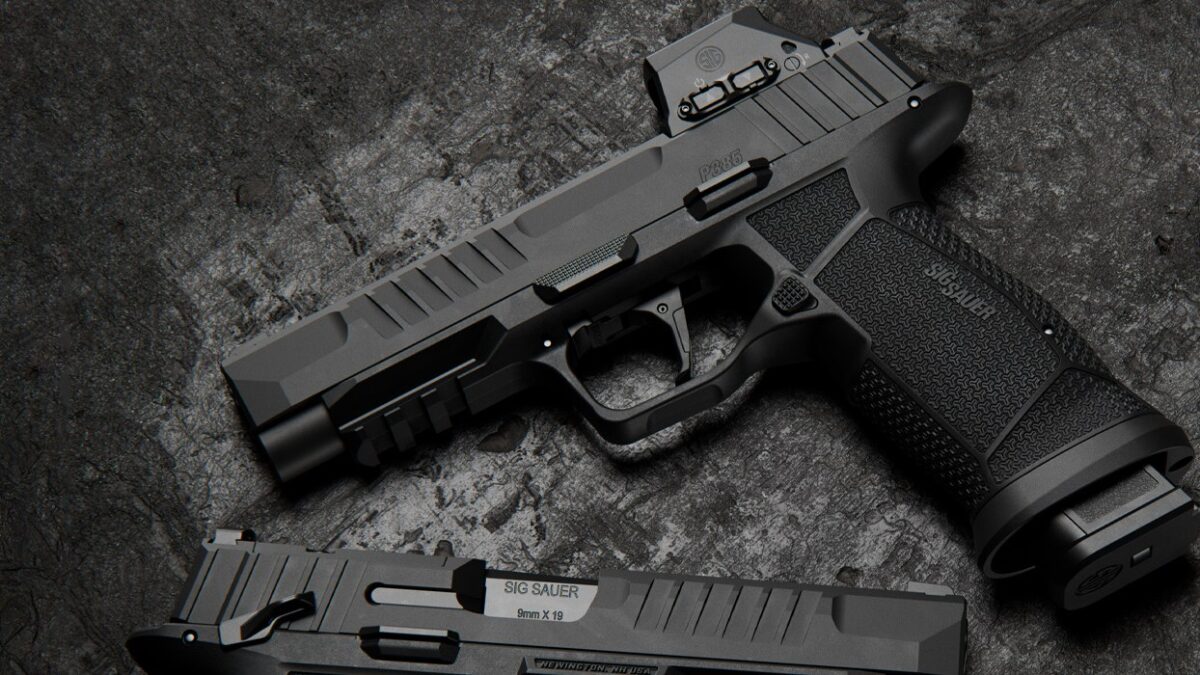
On Sept. 22, 2026, SIG Sauer unveiled the P385 at SIG NEXT, its in-house event in Newington, New Hampshire: a new family of modular 9 mm striker-fired pistols with a low bore axis, a built-in recoil damper and a new trigger safety. For sport shooters, it is the most interesting pistol debut in years. For Switzerland, it also amounts to an unintended commentary on its own armaments policy. A week earlier, the National Council, the lower house of parliament, had approved funding for the Swiss Armed Forces’ first 50,000 pistols of the P320 type, the very platform that SIG is now complementing with a spiritual successor. A look at the facts.
P320 plus P365 equals P385
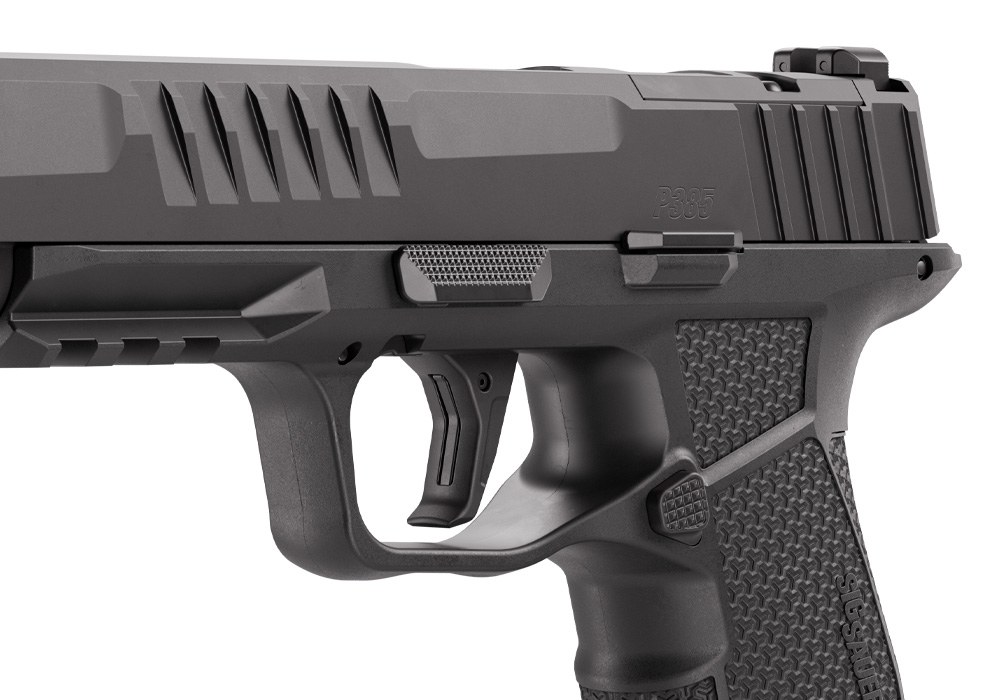
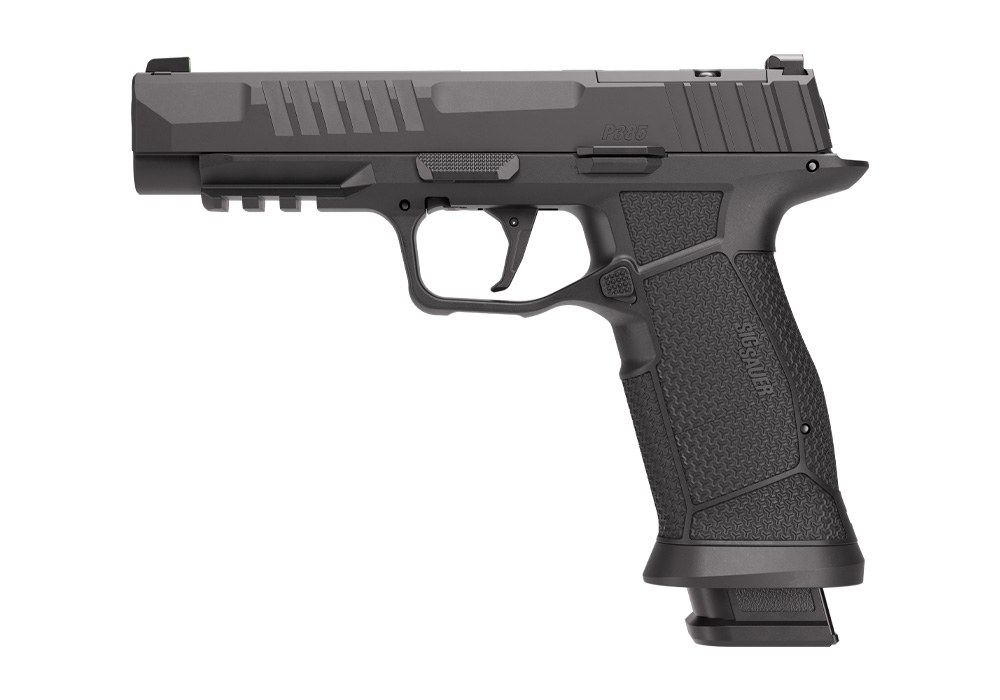
The name says it all. The P385 takes the magazine and the basic modular concept of the P320, pairs them with a trigger architecture modeled on the compact P365 and supplements both with new developments. At its heart is a dedicated, serialized Fire Control Unit (FCU) that can be swapped out together with the frame module. The slide and barrel are interchangeable; the barrel is made of carbon steel, the slide of stainless steel with a Nitron finish. Thanks to the new combination of a low bore axis and the SIG Recoil Dampening System (SRDS) in the grip frame, SIG promises at least 20% less muzzle rise, depending on the model. For the MACH3D version with an attached compensator, the manufacturer cites more than 30%.
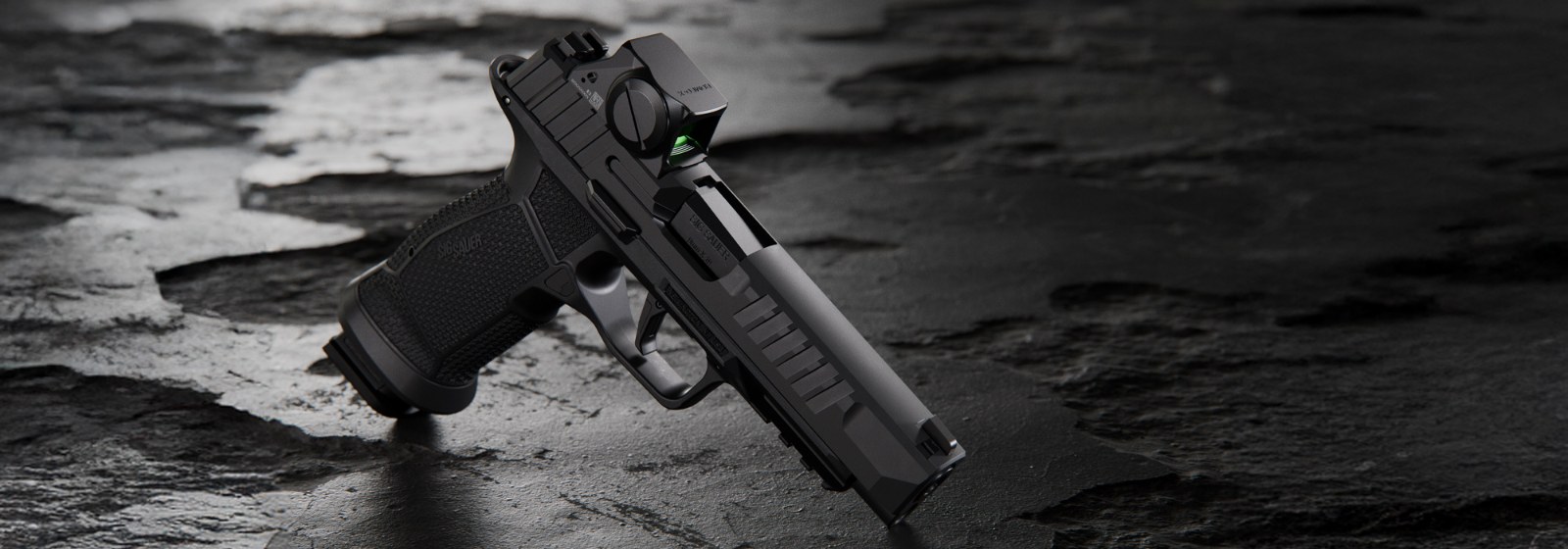
The grip is new as well. Instead of interchangeable backstraps, SIG relies on what it calls Magstraps: inserts that change the circumference, the trigger reach and even the grip height. One and the same grip frame can thus go from a 17-round full-size grip to a flush-fitting 15-round compact grip. The Magstraps come in sizes S, M and L; SIG gives the trigger reach as about 74 millimeters. All controls are ambidextrous; the slide catch lever is shielded so that the thumb does not inadvertently actuate it while shooting. Every version comes with the SIG-LOC PRO optic mount, which according to the manufacturer accepts common red dot sight footprints such as RMR and DPP without an adapter plate. A manual safety is available as an option.
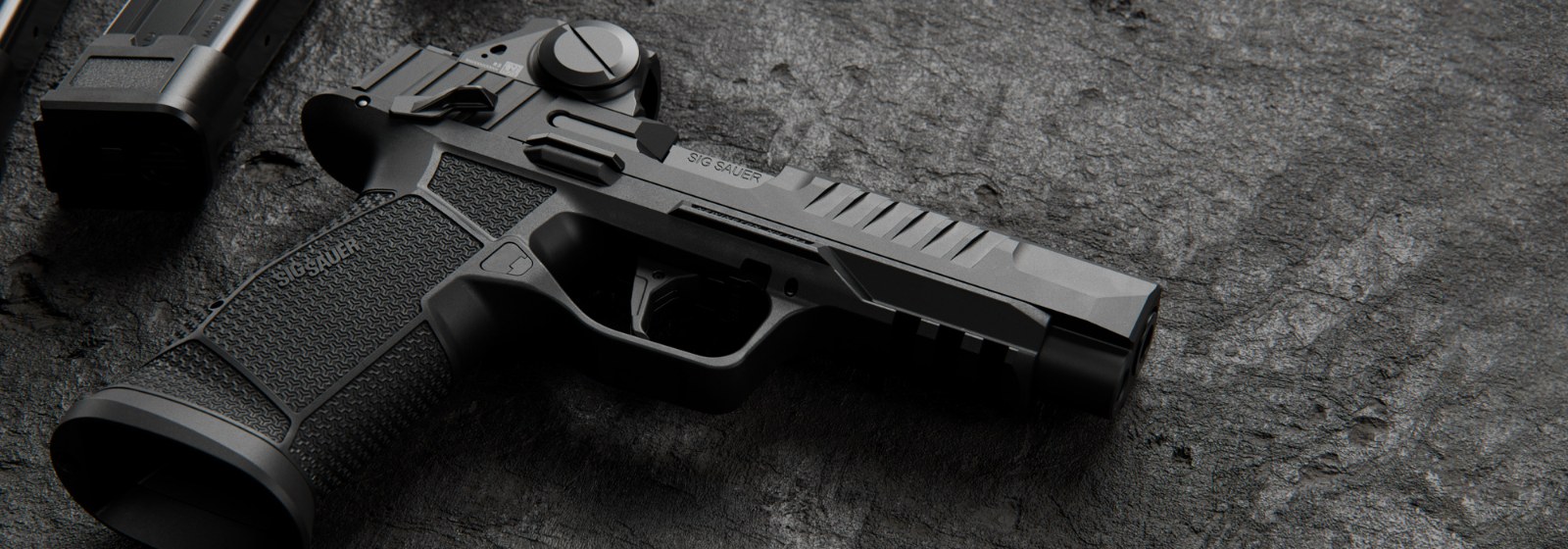
Perhaps the smartest decision is an unspectacular one: The P385 uses the P320’s standard magazines. Anyone who already owns a P320 can keep using their existing magazines, magazine pouches and loaders. The only caveat, according to the manufacturer: Older P320 magazines with a rounded base plate fit only once the P385’s metal magwell has been removed. Holsters, on the other hand, are not compatible, neither those for the P320 nor those for the P365. Apart from magazines, the AXG magwell and certain dovetail-mounted sights, all parts are specific to the P385.
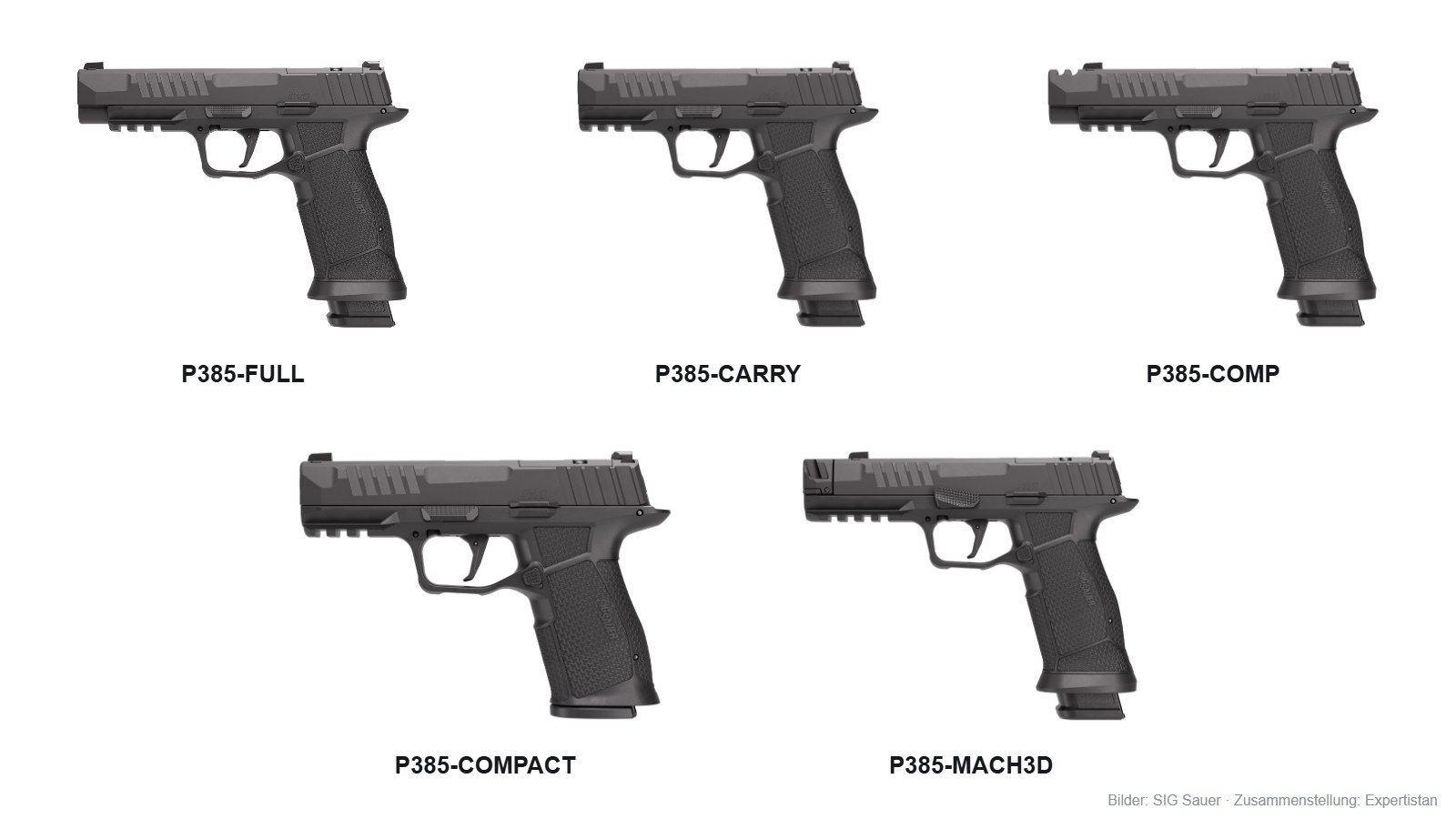
Five models at launch
| Model | Barrel | Length | Weight* | Magazines |
|---|---|---|---|---|
| FULL | 119 mm (4.7″) | 201 mm** | 840 g | 17 + 21 |
| CARRY | 102 mm (4″) | 183 mm | 820 g | 17 + 21 |
| COMP | 102 mm, compensated | 201 mm | 826 g | 17 + 2 × 21 |
| MACH3D | 86 mm (3.4″) plus compensator*** | TBA | 833 g | 17 + 21 |
| COMPACT | 102 mm (4″) | TBA | TBA | 2 × 15 |
SIG’s pricing is moderate by American standards. The full-size P385-FULL is listed on the manufacturer’s website at $599.99; one online retailer lists the compensated version with three magazines for $749.99. SIG has announced neither a price nor a delivery date for Switzerland. Experience shows that retail prices in Switzerland are noticeably higher than the U.S. list price because of import costs, customs duties and dealer margins; a reliable estimate will be possible only once the importer presents a price list.
P385-FULL specifications
| Caliber | 9 mm Luger (9 × 19) |
| Action | recoil-operated, striker-fired |
| Barrel length | 4.7 in. (119 mm), carbon steel |
| Overall length | 7.92 in. (201 mm)* |
| Height | 5.64 in. (143 mm) |
| Width | 1.32 in. (34 mm) |
| Sight radius | 6.55 in. (166 mm) |
| Weight with magazine | 29.6 oz. (about 840 g) |
| Capacity | 17 rounds flush, 21 rounds extended (10-round version available) |
| Sights | XRAY3 day/night, SIG-LOC PRO optic mount |
| Trigger | flat, with integrated Trigger Block |
| Accessory rail | M1913 (Picatinny) |
| U.S. list price | $599.99 |
The trigger is the real news
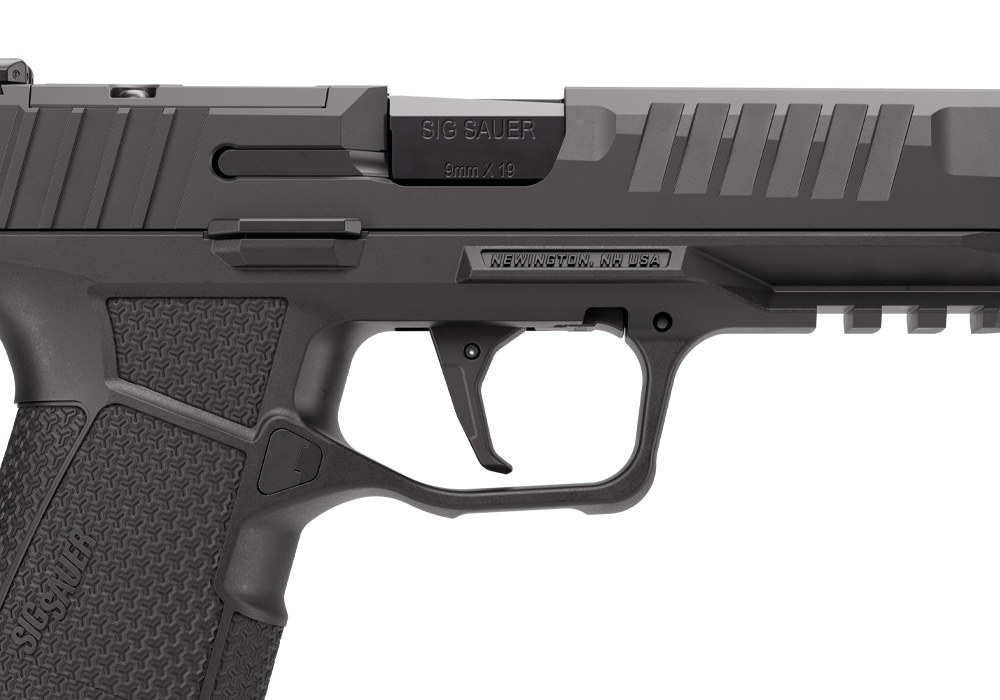
What generates the most technical discussion is a component that is barely visible. The P385 has a trigger safety, the Trigger Block. Unlike on pistols from Glock, Walther or Smith & Wesson, no blade protrudes from the trigger; the safety sits flush within the flat trigger face. A shooter who touches the trigger only from the side, without pressing its center, will not fire a shot. SIG describes the system as a redundant drop safety and stresses that the P385 passes all common drop tests even without the Trigger Block.
This is remarkable because for years SIG did without a trigger safety on the P320 and called one unnecessary. The military website We Are The Mighty commented pointedly on the change of course, running a headline to the effect that the P320 was apparently so safe that SIG was now bringing out the P385. In its official FAQ on the P385, SIG counters that the pistol had been in development for years and was not created because of the debates over the P320. Nor, SIG says, will the Trigger Block be carried over to the P320 or the P365 for the time being.
One need not take sides on this point to observe that, for buyers, agencies and instructors, an additional, mechanically independent safety is an argument that carries weight in procurement files. Whether it proves itself in everyday use, whether it is prone to fouling and how the trigger feels after a few thousand rounds, no one can credibly judge today. Accordingly, the specialist outlet Garand Thumb explicitly counts the durability of the Trigger Block among the points to watch.
Early verdicts from the range
There are no independent tests yet. What is available are impressions from specialist journalists and partner companies who got to shoot at the launch using the manufacturer’s guns and ammunition. That is customary with new products, but it is a caveat worth keeping in mind. Even so, the tenor is strikingly positive.
- GunsAmerica states that the P385 is not just another P320 variant but a platform in its own right. The MACH3D, it says, shot noticeably flatter than the other versions. The author acknowledges that a few hundred rounds at a manufacturer’s event amount to no more than a first impression.
- David Higginbotham, writing for the suppressor maker SilencerCo, says his first impressions are positive across the board; the gun, he writes, is easy to control, fast and responsive. He reserves final judgment because he had no opportunity to run actual drills.
- Thomas Higginbotham, reporting for the holster maker Safariland, says the triggers on early samples felt like about seven pounds (just over three kilograms). That is an estimate by feel, not a measured value.
- Gun Talk calls the P385 SIG’s most significant new pistol platform since the P365 and cites Gun Digest’s assessment that the P385 takes over the role of the P320, at least in spirit.
- We Are The Mighty remains skeptical, arguing that the P385 fills a gap in the lineup that does not actually exist because the P320 already occupies it.
Family comparison: From the Pistole 49 to the P385
For Swiss shooters, the SIG name has a special ring. The P210, known in military service as the Pistole 49, is still regarded as the benchmark for precision. The P220 was developed in the mid-1970s for the Swiss Armed Forces and, as the Pistole 75, has been the sidearm of generations of officers and specialists for half a century. With it, what was then the Schweizerische Industrie-Gesellschaft established the locking principle that, under the name SIG Sauer system, has found its way into countless pistols around the world. The P385 stands at the other end of this line: polymer grip, striker, optics from the factory, modularity as a principle.
| Model | Firing mechanism | Capacity (standard) | Role | Swiss connection |
|---|---|---|---|---|
| P210 | hammer, single action | 8 | precision and sport pistol | service pistol (Pistole 49) |
| P220 | hammer, DA/SA | 8 (military version) | service pistol | Pistole 75, armed forces since 1975 |
| P226 | hammer, DA/SA | 15 | law enforcement and sport pistol | widely used by sport shooters |
| P320 | striker, no trigger safety | 17 | modular service pistol, U.S. armed forces (M17/M18) | planned Pistole 26 |
| P365 | striker | 10 to 15 depending on version | concealed carry | no service role |
| P385 | striker, with Trigger Block | 17 / 21 (P320 magazines) | duty, sport, carry | not yet announced in Switzerland |
Compared with the P320, the differences are greater than the shared magazines might suggest. The FCU, grip frame, slide, barrel and holsters are new. The bore axis sits lower, which reduces the leverage the recoil exerts on the wrist. Compared with the P365, on the other hand, the P385 is clearly a full-size duty weapon with a double-stack magazine; for deep concealed carry, the P365 remains the slimmer option. SIG stresses that the P320 and P365 will remain in its lineup, including the M17 and M18 military versions.
The P320 controversy: Facts, not headlines
Anyone trying to put the P385 in context cannot avoid the P320. In the U.S., a dispute has been going on for years over what are known as “uncommanded discharges”: shots that, according to the person carrying the gun, went off without the trigger being pulled. The facts are contradictory and do not lend themselves to simple verdicts.
On one side are more than 100 lawsuits; two jury verdicts against SIG from 2024, including an $11 million verdict in Philadelphia; and a lawsuit filed by the state of New Jersey in October 2025 that seeks a halt to sales and a recall. Several agencies have retired the gun or paused its use, among them the Houston police and the Washington State Criminal Justice Training Commission, which has banned the P320, M17 and M18 from its training facilities. SIG is challenging that ban in court.
On the other side are the most extensive examinations to date. On Aug. 7, 2026, after a review involving more than 1.5 million rounds, the U.S. Department of Defense stated that all the incidents examined could be traced to the trigger being pulled, not to a defect in the weapon. After a fatal incident at F.E. Warren Air Force Base in July 2025, the U.S. Air Force inspected a total of 113,479 M18 pistols and found none in a condition that could have explained a discharge without the trigger being pulled. According to Army Times, reported weapons accidents involve less than 0.006% of the military pistols issued. In August 2026, a federal jury in Maine for the first time ruled in SIG’s favor on the merits in a P320 case. SIG also points to more than 20 lawsuits that have been dropped or dismissed.
One important distinction often gets lost in the debate: The M17 and M18 military versions have a manual safety; many civilian P320s do not. For the Swiss procurement, it is also crucial that the known problems of the P320 in the armasuisse procurement process concerned not safety but functional reliability. More on that shortly.
The Swiss pistol question
On Dec. 4, 2025, the Federal Office for Defence Procurement, armasuisse, announced that the P320 would succeed the Pistole 75. The requirement is 140,000 weapons; a first tranche of 50,000 was requested in the Armed Forces Dispatch 2026, with about 50 million Swiss francs budgeted. SIG Sauer pledged to set up production in Switzerland. According to the Swiss news site watson, the entire replacement is estimated to cost about 180 million francs over a service life of 30 years; introduction to the troops is planned to begin in 2028.
Three models were in the running: the Glock G45, the SFP9 from Heckler & Koch and the P320. According to armasuisse, only the Glock met all the criteria. What tipped the scales in SIG’s favor was an overall assessment that, according to the press release, showed substantial advantages for the P320 in terms of armaments policy and economics, namely the lowest price and domestic production. Under Switzerland’s Freedom of Information Act, watson has since obtained access to the technical test report. The numbers are unambiguous.
In the so-called service-life firing test, with 20,000 rounds of service ammunition each, conducted from March to May 2025 in the firing tunnel of SwissP Defence AG in Thun, the testers recorded 16 malfunctions for the Glock, 24 for the SFP9 and 464 for the P320. According to watson, the report gives the P320 a malfunction rate of 7.99 per 1,000 rounds; 2 were permitted. Arithmetically, the pistol thus stopped on average once every 125 rounds; at least 500 were required. That rate, however, cannot be reconciled with 464 malfunctions: Over 20,000 rounds, it would equal about 160. The excerpts published by watson do not show which figure is correct. According to the report, almost all malfunctions had the same cause: The slide did not close completely when a new round was fed. The P320 also fared worst in the troop trials; in the fall of 2025, the Armed Forces Logistics Organisation refused to certify it as fit for troop use.
For its part, armasuisse puts the findings in perspective. As reported by SRF, the Swiss public broadcaster, the agency says the poor marks from the troop trials were based on subjective criteria such as handling and ergonomics and did not reflect technical safety. The malfunction rate had been corrected with a “marginal adjustment,” armasuisse spokesman Kaj-Gunnar Sievert told watson, specifically by “polishing the feed edge.” Proof of a rate below 2 per 1,000 rounds had been provided in early June 2026, the agency said. However, the final configuration of the Swiss Armed Forces’ P320 could not be communicated to SIG Sauer Switzerland until early September 2026. According to armasuisse, a pre-production series made in Switzerland will be available for requalification and troop testing in mid-2027 at the earliest.
| Date | Event |
|---|---|
| March to May 2025 | Service-life firing test in Thun, 20,000 rounds each |
| Fall 2025 | Armed Forces Logistics Organisation refuses to certify the P320 as fit for troop use |
| Oct. 30, 2025 | Technical test report by armasuisse |
| Dec. 4, 2025 | P320 selected, commitment to production in Switzerland |
| March 26, 2026 | Presentation of the Pistole 26 in Thun along with the Armed Forces Dispatch |
| Early June 2026 | armasuisse: malfunction rate below 2 per 1,000 rounds demonstrated |
| June 2026 | Council of States (upper house) approves the Armed Forces Dispatch, motion to forgo the purchase rejected |
| Sept. 15, 2026 | National Council votes 132 to 63, with one abstention, to keep the funding |
| Sept. 22, 2026 | SIG Sauer launches the P385 in the U.S. |
| From mid-2027 | Requalification of the Swiss pre-production series, troop testing |
| From 2028 | Planned introduction to the troops |
For and against in parliament
The National Council debate of Sept. 15, 2026, followed familiar lines. The Swiss People’s Party (SVP), FDP.The Liberals, The Centre and the Green Liberals (GLP) voted en bloc for the funding. FDP National Councillor Heinz Theiler, according to watson, stressed domestic value added of about 90% and the lowest life-cycle costs of all the models tested; the deficiencies, he said, could be fixed and did not affect safety. The SVP argued for fully equipping every member of the armed forces and pointed to the independence that licensed production would bring. The Centre noted that the stock of serviceable Pistole 75 handguns would be exhausted within a few years. The GLP said the lack of certification for troop use deserved criticism but trusted the assurances of the Federal Council (the Swiss government) and armasuisse.
The Social Democrats (SP) and the Greens moved to strike the 50 million or to redirect it to defense against mini-drones. SP National Councillor Benoît Gaillard said the P320 was being retained “contrary to all logic given such an evaluation” and proposed requesting the funding a year later, once a tested model was available. The motion was clearly defeated. An important point for context: The funding approval does not seal the purchase once and for all. The Swiss P320 will be procured only if the pre-production series passes requalification and the armed forces confirm that it is fit for troop use.
Should the armed forces have waited for the P385?
The question suggests itself but is quickly answered: No, at least not from today’s perspective. The P385 was never part of the evaluation; it has been neither trialed in Switzerland nor tested with the Pist Pat 14 service ammunition. Swiss production is not in sight. A switch would have sent the process back to square one, at the very moment when the stock of Pistole 75 handguns, by the supporters’ account, is running low. Moreover, for a military that intends to use a weapon for three decades, a brand-new platform carries a risk of its own: Teething problems show up only after hundreds of thousands of rounds in users’ hands, not at a launch event.
The P385 does, however, raise a different and legitimate question: whether Switzerland is buying a platform at the end of its innovation cycle. When the manufacturer puts its newest ideas on trigger, recoil and ergonomics into a new family and explicitly does not carry the Trigger Block over to the P320, the P320 becomes a mature platform. That need not be a disadvantage. Mature weapons are well documented; spare parts and magazines are available worldwide. The U.S. armed forces will go on using the M17 and M18 for years to come. But it does mean that with the P320, the armed forces are betting on the proven rather than the newest. For a service weapon, that is more a virtue than a flaw, provided the pre-production series lives up to what has been promised.
What the P385 means for Swiss sport shooters
For sport shooting, the P385 is welcome news. SIG explicitly positions it for competition as well, citing divisions such as Carry Optics and Open, which are common in dynamic shooting under the rules of the United States Practical Shooting Association (USPSA). A low bore axis, recoil damping, a compensator and a factory red dot sight are exactly the ingredients that save time on a course of fire. Anyone who already shoots a P320 has an inexpensive way in thanks to the magazine compatibility.
Those interested should keep three points in mind. First, availability in Switzerland is uncertain; SIG has so far announced nothing for Europe. Second, the 21-round magazine supplied from the factory is no mere detail. Since Aug. 15, 2019, magazines holding more than 20 rounds for semi-automatic handguns have been classified as high-capacity magazines (Art. 4 para. 2bis of the Swiss Weapons Act). A pistol with a 17-round magazine can still be bought with a weapon acquisition permit; together with the 21-round magazine, however, it becomes a prohibited weapon and requires an exemption permit. Sport shooters are entitled to an exemption permit under simplified conditions if they belong to a shooting club or shoot regularly (Art. 28d of the Weapons Act); proof must be provided again after five and after 10 years. Anyone who wants to use the P385 with 17-round magazines only should expressly agree on this at the time of purchase; the details are best clarified in advance with the cantonal firearms office. Third, the selection of holsters will be thin in the first few months; SIG names Safariland, ANR and BlackPoint as the first manufacturers.
Risks and open questions
| Issue | Status as of Oct. 4, 2026 | Assessment |
|---|---|---|
| P385 reliability | manufacturer event only, no long-term tests | unresolved |
| Trigger Block | new, patented, not yet proven in the field | promising, to be watched |
| Availability in Switzerland | not announced | unresolved |
| Swiss P320 (Pistole 26) | pre-production series mid-2027 at the earliest | schedule and quality risk |
| P320 litigation in the U.S. | mixed verdicts, military affirms safety | reputational risk, technically disputed |
| Armed forces’ Plan B | Glock G45 as the only candidate that met all criteria | available |
Commentary: A good sign for the sport, a warning to procurement officials
As far as can be judged after the first few weeks, the P385 is a serious feat of engineering. It responds to the legitimate wishes of sport shooters and those who carry a duty weapon: less muzzle rise, a grip that adapts to the hand rather than the other way around, optics without tinkering and an additional safety that does not degrade the trigger. That SIG carries over the P320’s magazines in the process is customer-friendly and smart. For sport shooting, which is deeply rooted in Switzerland and ranges from the Feldschiessen, a nationwide annual shooting event, to dynamic courses of fire, every innovation of this kind is a gain.
For the armed forces, the lesson is a different one. The problem with the Pistole 26 is not the SIG brand, whose name is tied to the Swiss firearms tradition like hardly any other. The problem is a process in which the mandatory technical criteria were first defined and then relaxed in favor of industrial policy goals. Domestic production is a legitimate goal, especially in uncertain times. But it does not justify compromising on the reliability of a weapon on which soldiers must rely in a real emergency. The way to win back trust is clear: The requalification of the pre-production series must be carried out to the same standards as the original trials. The results should be published. If the Swiss P320 passes, Switzerland will have its own pistol production and a modern service weapon. If it fails, Plan B is on the table. Either outcome is better than a compromise that no one wants to talk about anymore.
Notes on the data
The technical data on the P385 come from the manufacturer and from reports by specialist media that were able to shoot at a manufacturer’s event; independent measurements are lacking. Some manufacturer specifications are contradictory (overall length, assignment of barrel lengths). One retailer site has already reported deliveries in the U.S., while SIG still lists the models as coming soon. The figures from the armasuisse test report have not been made public; they come from partly redacted documents that watson viewed under the Freedom of Information Act. Information on U.S. court cases relies in part on secondary sources. All figures as of Oct. 4, 2026. Statements originally made in English are paraphrased. Quotes originally given in another language were translated by the editors. Sources are cited in their original language.
Sources
SIG Sauer: product pages for the P385 and P385-FULL including FAQ (sigsauer.com); SIG Sauer, press release of Sept. 22, 2026 (PR Newswire); The Firearm Blog, Sept. 23, 2026; Soldier Systems Daily, Sept. 23 and Aug. 21, 2026; Recoil, Sept. 23, 2026; Gun Talk, Sept. 23, 2026; GunsAmerica; SilencerCo; Safariland; Garand Thumb; We Are The Mighty; Primary Arms; armasuisse, press release of Dec. 4, 2025; watson.ch, reports of April 2, Sept. 15 and Sept. 16, 2026; SRF, March 26, 2026; 20 Minuten, March 26, 2026; Tages-Anzeiger, June 2026; Allianz Sicherheit Schweiz, Sept. 15, 2026; Army Times, Aug. 19, 2026; Police1; Homeland Arms, March 28, 2026; Pew Pew Tactical; KY Gun Co.; Bauer Precision; Classic Firearms; Bundesgesetz über Waffen (Waffengesetz, WG) and Waffenverordnung (fedlex.admin.ch); Schweizer Schiesssportverband, information on the Weapons Act.



Comments 0