Popular vote alone or cantons too? The question that could decide the fate of Bilaterals III
From early December, Switzerland’s National Council debates Bilaterals III. At the center is a question that could decide whether the package passes or fails: Is a popular majority enough at the ballot box, or does it also take a majority of the cantons? A preview with the positions, the legal opinions and an analysis of past votes on Europe.
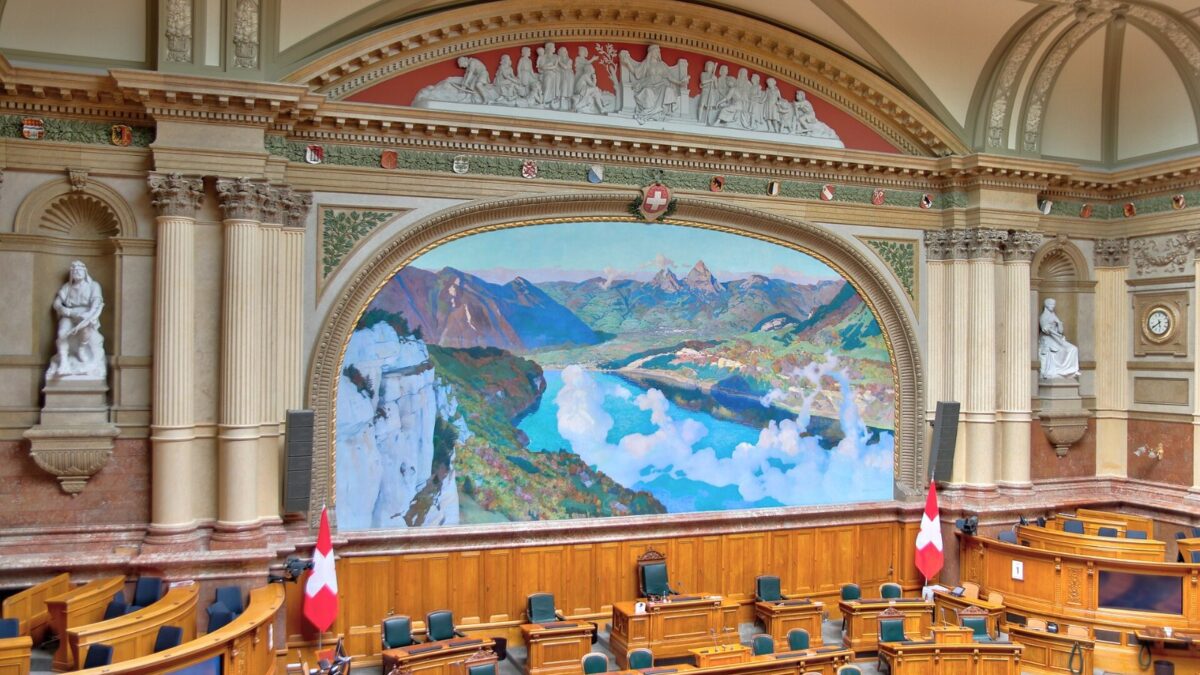
Rarely has a procedural question shaped Switzerland’s European policy as much as this one. Swiss voters will one day decide on the new agreements with the European Union at the ballot box; that much is undisputed. What is disputed is which rules will apply. Will a majority of those voting be enough, as the Federal Council wants? Or will a majority of the cantons also be required, as the Council of States decided at the end of September? From the second week of the winter session, which opens on Monday, Nov. 30, 2026, it is the National Council’s turn to weigh in.
The answer is more than a legal nicety. Political scientists Rahel Freiburghaus and Adrian Vatter have calculated that Bilaterals III would need around 55% of the popular vote to be sure of winning a majority of the cantons. The cantonal majority would thus raise the bar by about 5 percentage points. History shows how much that can matter: The 2005 vote on Schengen and Dublin, clearly approved with 54.6% in favor, would have failed if a majority of the cantons had been required.
The National Council’s preparatory committees are divided. The Political Institutions Committee wants the cantonal majority, most recently by 14 votes to 11. The Foreign Affairs Committee, which is in charge of the dossier, backs a popular majority alone by 15 votes to 10. The vote in the full chamber is likely to be close. This preview explains what is at stake, which arguments the two camps put forward and what past votes on Europe reveal about the prospects of Bilaterals III.
The case at a glance
| Item | Status as of Nov. 28, 2026 |
|---|---|
| Proposal | The package for the stabilization and further development of Switzerland-EU relations (26.023), known as Bilaterals III; the stabilization part is the first of four federal decrees |
| Federal Council | Optional referendum; a popular majority is enough |
| Council of States | On Sept. 30, 2026, in favor of a mandatory “sui generis” referendum requiring a majority of the people and the cantons; the Federal Council’s proposal was defeated by 23 votes to 17 with 3 abstentions |
| National Council’s Political Institutions Committee | In favor of the mandatory sui generis referendum: first by 15 votes to 10, then by 14 votes to 11 against a compromise built around the Compass Initiative (Kompass-Initiative) and in the overall decision |
| National Council’s Foreign Affairs Committee (lead committee) | By 15 votes to 10 in favor of the optional referendum; final vote on the stabilization part 15 to 9 with 1 abstention |
| Federal Office of Justice | The constitution does not allow a mandatory referendum for these agreements, not even as an exception |
| National Council | Debate in the second and third weeks of the winter session, which runs from Nov. 30, 2026, to Dec. 18, 2026 |
| Next steps | The Council of States has not scheduled the reconciliation of differences for the winter session; a final decision by parliament will come later |
| Popular vote | According to Swiss public broadcaster SRF, 2028 at the earliest |
Timeline: From the end of negotiations to the winter session
| Date | Event |
|---|---|
| March to December 2024 | Switzerland and the EU negotiate the package. It comprises 94 EU legal acts, 18 agreements and protocols as well as two joint declarations. |
| Aug. 29, 2025 | The Compass Initiative is submitted. It calls for a majority of the cantons for treaties that provide for a significant adoption of law and contains a transitional provision on Bilaterals III. |
| Nov. 26, 2025 | The Federal Council rejects the Compass Initiative and comes out in favor of the optional referendum. |
| March 2, 2026 | Swiss President Guy Parmelin and European Commission President Ursula von der Leyen sign most of the agreements in Brussels. |
| March 4, 2026 | The Council of States rejects, by 23 votes to 22, a motion to put the Compass Initiative to a vote before the EU agreements. |
| March 13, 2026 | The Federal Council sends its dispatch to parliament. |
| June 11, 2026 | The Council of States postpones the debate on the cantonal majority to the fall session. |
| June 14, 2026 | Voters reject the SVP’s initiative against a Switzerland of 10 million people with 54.8% of the vote. |
| Aug. 12, 2026 | The Federal Council adopts its dispatch on the Compass Initiative and recommends rejecting it. |
| Sept. 30, 2026 | The Council of States opts for a majority of the people and the cantons. |
| Oct. 1, 2026 | After some 22 hours of debate, the Council of States approves the stabilization part. |
| Nov. 12, 2026 and Nov. 13, 2026 | The National Council’s Political Institutions Committee comes out in favor of the cantonal majority. |
| Nov. 16, 2026 to Nov. 18, 2026 | The National Council’s Foreign Affairs Committee comes out in favor of the popular majority and concludes its preliminary deliberations. |
| December 2026 | Debate in the National Council. |
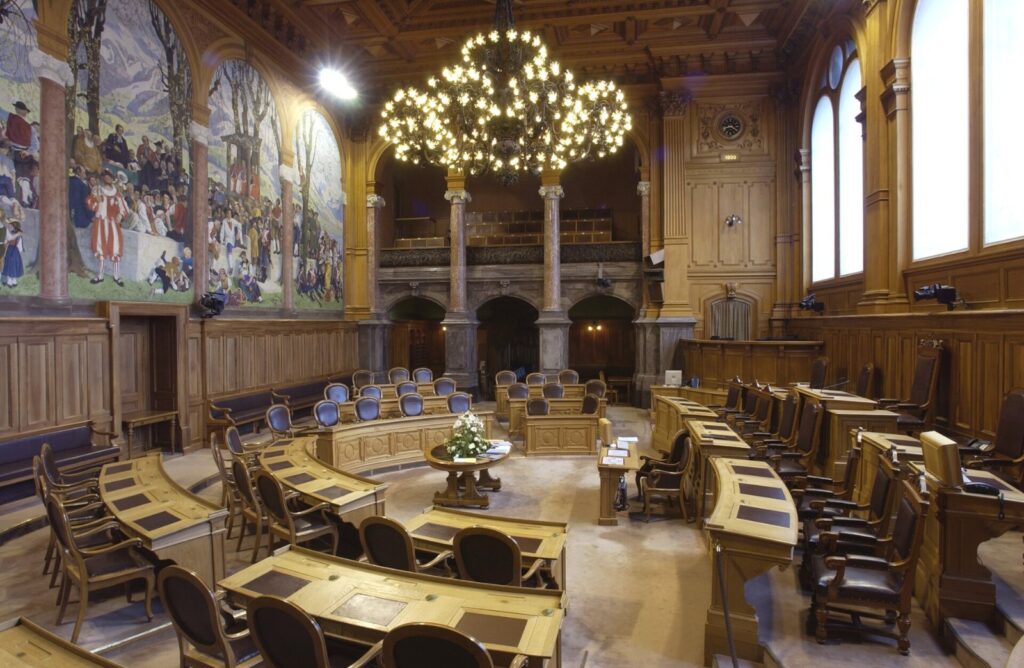
What Bilaterals III is about
The package is meant to put bilateral relations on a new footing. In the existing and new single market agreements, Switzerland would in the future adopt relevant EU law dynamically, meaning not automatically but according to a defined procedure. Disputes would be settled by an arbitration panel, which would have to consult the Court of Justice of the EU on questions concerning the interpretation of EU law. There are also new agreements on electricity, health and food safety as well as regular Swiss contributions to cohesion within the EU.
The Federal Council has divided the package into four federal decrees subject to referendum: one for stabilizing relations and one each for electricity, health and food safety. Without the stabilization part, none of the new agreements can enter into force. The dispute over the cantonal majority revolves around this stabilization part.
In the fall session, the Council of States approved the package in principle but set its own priorities; it has not yet debated the electricity agreement. On wage protection, it followed the compromise reached by the social partners. On immigration, it added further hurdles, such as a levy when the safeguard clause is invoked and restrictions on permanent residence. The National Council’s Political Institutions Committee wants to soften these tougher rules so that they remain compatible with the Agreement on the Free Movement of Persons.
What the cantonal majority means
The Swiss Federal Constitution provides for two kinds of referendum. In a mandatory referendum, both the people and the cantons must approve. It applies to amendments to the constitution, to joining organizations for collective security or supranational communities and to federal acts declared urgent that lack a constitutional basis and remain in force for more than a year. In an optional referendum, which 50,000 eligible voters or eight cantons can request within 100 days, the popular majority alone decides. International treaties containing important legislative provisions are also subject to this referendum. A cantonal majority is achieved when a proposal is approved in a majority of the cantons. Of the 23 cantonal votes, at least 12 are needed, with each of the six cantons that have half a cantonal vote counting as 0.5.
There is also a practice outside the text of the constitution: the mandatory referendum “sui generis.” Parliament may voluntarily submit a treaty of major significance to the people and the cantons. This procedure has been used three times so far: for joining the League of Nations in 1920, for the free trade agreement with what was then the European Economic Community in 1972 and for the EEA Agreement in 1992. This is exactly the route the Council of States chose. It also adopted a proposal for a separate constitutional amendment that would likewise require the double majority.
The Federal Office of Justice takes a different view. In an analysis, it concluded that under the constitution, the EU agreements cannot be subjected to a mandatory referendum, not even as an exception. The Federal Council relies on this assessment. The National Council’s Foreign Affairs Committee also justifies its decision by arguing that the agreements contain no supranational elements. Legal scholars are divided, however, as a public hearing held by the Council of States committee showed.
The arguments in parliament
The cantonal majority is backed mainly by the SVP as well as parts of the FDP and the Center Party. Council of States member Andrea Caroni (FDP, Appenzell Outer Rhodes) said during the fall session that only a double majority would do justice to the significance of the agreements. “The advantages are obvious: A cantonal majority strengthens legitimacy and resolves all constitutional concerns.” Heidi Z’graggen (Center, Uri), who chairs the Council of States’ Political Institutions Committee, pointed out that the agreements affect parliament’s legislative powers and the participation of the cantons. “The cantonal majority is an expression of our federal balance.” FDP Council of States member Petra Gössi argued that a double majority would lead to greater legitimacy and stronger trust.
On the other side are the Federal Council, the Social Democrats, the Greens, the Green Liberals as well as parts of the FDP and the Center. The Greens had already described the committee’s decision as a “Buebetrickli” (Swiss German for a schoolboy’s trick) and as unnecessary, dangerous sabotage of the bilateral path. Justice Minister Beat Jans, whose department includes the Federal Office of Justice, told watson in an interview published Nov. 27, 2026, that there is no constitutional basis for requiring a majority of the cantons for international treaties and that there should not be one. “Anyone who insists on the cantonal majority is playing a tactical game,” he said. In its press release, the National Council’s Foreign Affairs Committee states that it considers the optional referendum, with a popular majority alone, to be the constitutionally correct form of referendum. Good relations with the EU are a strategic necessity for Switzerland, the committee says. A minority, by contrast, sees Bilaterals III as a serious intrusion into Switzerland’s internal structure.
Former Center Party President Gerhard Pfister tried to find a middle way. He proposed that voters first decide on the Compass Initiative, that is, on the rules of the game. “I assume that the decision on a cantonal majority will be close in parliament, which is why it is better to let the population decide,” he told SRF. The National Council’s Political Institutions Committee preferred the mandatory referendum to such a compromise by 14 votes to 11.
What past votes on Europe show
Past votes on Europe show how high the hurdle of the cantonal majority is. Most major proposals since 2000 were subject to the optional referendum, so the cantonal majority played no role. Calculating it anyway yields a revealing picture.
| Vote | Popular yes share | Cantonal votes yes to no | With cantonal majority |
|---|---|---|---|
| EEA Agreement, Dec. 6, 1992 (mandatory) | 49.7% | 7 to 16 | rejected |
| Bilaterals I, May 21, 2000 | 67.2% | 21 to 2 | approved |
| Schengen and Dublin, June 5, 2005 | 54.6% | 11 to 12 | failed |
| Extension of the free movement of persons, Sept. 25, 2005 | 56.0% | 17.5 to 5.5 | approved |
| Continuation of the free movement of persons, Feb. 8, 2009 | 59.6% | 19.5 to 3.5 | approved |
The table shows two things. First, the cantonal majority is no hurdle when results are clear: Bilaterals I and the continuation of the free movement of persons would have cleared it with ease. Second, with results around 55%, it becomes a lottery. In 2005, Schengen and Dublin won 54.6% of the popular vote, but only 10 cantons and two half-cantons approved. With a cantonal majority, the proposal would have failed by 11 cantonal votes to 12. Besides most central Swiss cantons and Ticino, large cantons such as Aargau, St. Gallen and Lucerne had voted no, the latter by the narrowest of margins with 49.6% in favor.
The reverse case was the vote of June 14, 2026, on the SVP’s initiative against a Switzerland of 10 million people. It was rejected with 54.8% voting no; among the cantons, the result was 13 votes to 10. Although only 45.2% of voters approved it, the initiative thus won almost half of the cantonal votes. This illustrates the asymmetry calculated by Freiburghaus and Vatter: Through the cantonal majority, the small, rural and rather Euroskeptic cantons carry a weight that clearly exceeds their share of the population. For the 1992 EEA vote, the two researchers calculated that, assuming a uniform increase across all cantons, a popular majority of 59.6% would have been needed to win a majority of the cantons.

Where public opinion stands
Polls so far show a majority in favor of Bilaterals III. A survey by the research institute Sotomo from June 2026 found 59% support and 33% opposition, according to nau.ch. Political scientist Stefanie Walter of the University of Zurich believes the chances remain intact. “It remains open whether voters will approve Bilaterals III. But the chances are at least intact,” she told nau.ch. After voters rejected the 10 million initiative, Lukas Golder of the research institute GFS Bern pointed out to SRF that attempts to win the population over to a critical stance had failed.
But a poll is not a vote result. Well over a year is likely to pass before the vote. Approval ratings can shift considerably during a campaign. If approval ends up in the range of 55%, the form of the referendum will decide whether the package passes or fails.
Claims fact-checked
| Claim | Finding |
|---|---|
| “The constitution requires a cantonal majority for the EU agreements.” | Disputed. The Federal Office of Justice clearly says no. Supporters rely on the practice of the sui generis referendum of 1920, 1972 and 1992. |
| “Parliament is not allowed to impose a cantonal majority at all.” | Also disputed. The sui generis referendum is a practice outside the text of the constitution; its use for Bilaterals III is legally contested. |
| “With a cantonal majority, a yes is impossible.” | False. Bilaterals I and the free movement of persons in 2005 and 2009 would have won a majority of the cantons. According to calculations by political scientists, the bar lies at around 55% yes. |
| “The cantonal majority is a mere formality.” | False. Schengen and Dublin would have failed on the cantonal majority in 2005 despite 54.6% in favor. |
| “The vote will take place in 2027.” | Unlikely. According to SRF, the people will vote in 2028 at the earliest; the Council of States has not scheduled the reconciliation of differences for the winter session. |
| “The National Council has the final say.” | No. If it departs from the Council of States, the bill goes back. If disagreement persists, a conciliation conference proposes a solution that both chambers must approve; if one chamber rejects it, the bill fails. |
The Arena: Does the EU treaty package need a cantonal majority?
On contested questions, Expertistan sets out the strongest arguments on both sides.
Yes: The cantons must have a say
- Significance: Dynamic adoption of EU law fundamentally changes the relationship with the EU. For Andrea Caroni, only a double majority does justice to the significance of the agreements.
- Federalism: The agreements affect the powers of the cantons and of parliament. For Heidi Z’graggen, the cantonal majority is an expression of the federal balance.
- Legitimacy: A yes from both the people and the cantons would be almost impossible to challenge politically and, according to supporters, would also dispel constitutional concerns.
- Precedents: Joining the League of Nations in 1920, the 1972 free trade agreement and the 1992 EEA Agreement were all put to the people and the cantons.
- Legal certainty: The pending Compass Initiative could later call into question a yes achieved without a cantonal majority. A double majority would avoid this dispute.
No: A popular majority is enough
- Constitution: According to the Federal Office of Justice, the constitution does not permit a mandatory referendum for these agreements, not even as an exception. The Foreign Affairs Committee also argues that the agreements contain no supranational elements.
- Proven practice: Bilaterals I, Schengen and Dublin as well as the free movement of persons were subject to the optional referendum.
- Rules of the game: Raising the bar for this particular package means changing the rules once the game is already underway. The Greens speak of a “Buebetrickli.”
- Equality of votes: The cantonal majority gives votes from small cantons many times more weight. For agreements that affect the whole country, that is hard to justify.
- Strategic importance: According to the Foreign Affairs Committee, good relations with the EU are a strategic necessity. An artificially raised hurdle endangers the bilateral path.
What comes next
The National Council will debate the EU treaty package in the second and third weeks of the winter session, that is, from Dec. 7, 2026, to Dec. 18, 2026. Besides the referendum question, wage protection, the safeguard clause, the immigration levy introduced by the Council of States and the permanent residence rights of EU citizens are up for debate. Numerous minority proposals seek to further limit immigration into the welfare system; others reject the package altogether.
If the National Council follows its Foreign Affairs Committee and opts for the popular majority, a difference with the Council of States will arise. The latter has not scheduled the reconciliation for the winter session. A final decision is therefore possible next year at the earliest; if the dispute persists, it will go through a conciliation conference whose proposal both chambers must approve. In between come the federal elections of Oct. 24, 2027, which could shift the balance of power on the European question. And hanging over everything is the Compass Initiative, on which the people and the cantons will also vote unless it is withdrawn.
Commentary: Don’t move the hurdle in the middle of the race
The cantonal majority is one of the great achievements of the Swiss federal state. It protects the small cantons from being outvoted by the large ones. Anyone who dismisses it lightly as an obstacle fails to appreciate its value. But precisely because the cantonal majority is so important, it should not become a tactical instrument.
Bilaterals III is a treaty package of great significance; that is undisputed. It is equally undisputed that the constitution provides for the optional referendum for international treaties containing important legislative provisions and that Switzerland approved the previous bilateral agreements this way. The Federal Office of Justice considers a mandatory referendum inadmissible. One need not share this assessment. But anyone who wants to depart from it should amend the constitution, openly and for all future treaties, instead of creating, for a single package, a special rule whose effect everyone knows.
For that is the core of the unease. Some supporters of the cantonal majority make no secret of the fact that they reject the package. The numbers prove them right: Schengen would have failed on the cantonal majority. A rule chosen because it makes a particular outcome more likely loses its legitimacy. That applies in both directions.
The National Council has it in its power to bring this debate back to the facts. It should stick to the proven form of the optional referendum. The fundamental question of whether treaties with dynamic adoption of EU law should in the future generally be subject to a cantonal majority should be left to the people and the cantons through the Compass Initiative. The sovereign would then decide on the rules of the game. And it would not do so in the middle of the race.
Editor’s note
The calculation of cantonal votes for past votes that were subject to the optional referendum is based on the cantons’ official yes shares and shows a hypothetical result. In the 1992 EEA vote, a cantonal majority was actually required. The vote results come from the Federal Statistical Office, Swissvotes and cantonal authorities. Poll figures are snapshots. The commentary reflects the opinion of the editorial team. Quotes have been translated from German by the editorial team. Article as of Saturday, Nov. 28, 2026.
Sources
- 1. Parlamentsdienste, Medienmitteilung der APK-N, 18.11.2026: https://www.parlament.ch/press-releases/Pages/mm-apk-n-2026-11-18.aspx
- 2. Parlamentsdienste, Medienmitteilung der SPK-N, 16.11.2026: https://www.parlament.ch/press-releases/Pages/mm-spk-n-2026-11-16.aspx
- 3. Parlamentsdienste, Medienmitteilung der SPK-S, 30.06.2026: https://www.parlament.ch/press-releases/Pages/mm-spk-s-2026-06-30.aspx?lang=1031
- 4. Parlamentsdienste, Medienmitteilung der SPK-S, 27.03.2026: https://www.parlament.ch/press-releases/Pages/mm-spk-s-2026-03-27-a.aspx
- 5. Parlamentsdienste (SDA), «Ständerat will Ständemehr für EU-Verträge», 30.09.2026: https://www.parlament.ch/de/services/news/Seiten/2026/20260930202710041194158159026_bsd174.aspx
- 6. Parlamentsdienste (SDA), Abschluss der Debatte im Ständerat, 01.10.2026: https://www.parlament.ch/de/services/news/Seiten/2026/20261001092453818194158159026_bsd055.aspx
- 7. Parlamentsdienste (SDA), Bilanz der Ständeratsdebatte, 01.10.2026: https://www.parlament.ch/de/services/news/Seiten/2026/20261001152151087194158159026_bsd131.aspx
- 8. Parlamentsdienste (SDA), Eintretensdebatte im Ständerat, 28.09.2026: https://www.parlament.ch/de/services/news/Seiten/2026/20260928205711647194158159026_bsd154.aspx
- 9. Parlamentsdienste (SDA), Motion Schmid zur Kompass-Initiative, 04.03.2026: https://www.parlament.ch/de/services/news/Seiten/2026/20260304132039002194158159026_bsd104.aspx
- 10. Parlamentsdienste, Wintersession 2026: https://www.parlament.ch/agenda/Pages/wintersession-2026.aspx?lang=1031
- 11. cash.ch (AWP), «Federführende Nationalratskommission gegen Ständemehr beim EU-Paket», 18.11.2026: https://www.cash.ch/news/federfuhrende-nationalratskommission-gegen-standemehr-beim-eu-paket-986288
- 12. SRF News, «Nationalratskommission will Ständemehr für EU-Vertragspaket», 16.11.2026: https://www.srf.ch/news/schweiz/eu-vertragspaket-nationalratskommission-will-staendemehr-fuer-eu-vertragspaket
- 13. SRF News, «EU-Paket soll laut Ständerat Volk und Ständen vorgelegt werden», 30.09.2026: https://www.srf.ch/news/schweiz/neue-bilaterale-vertraege-eu-paket-soll-laut-staenderat-volk-und-staenden-vorgelegt-werden
- 14. SRF News, «Soll das Volk zuerst über das Ständemehr bei EU-Paket abstimmen?», 2026: https://www.srf.ch/news/schweiz/eu-vertragspaket-soll-das-volk-zuerst-ueber-das-staendemehr-bei-eu-paket-abstimmen
- 15. SRF News, «EU-Vertragspaket: Ständeratskommission will Volks- und Ständemehr», 2026: https://www.srf.ch/news/schweiz/bilaterale-beziehungen-eu-vertragspaket-staenderatskommission-will-volks-und-staendemehr
- 16. SRF News, «Abstimmungstermin Juni 2027: Taktik oder richtiger Zeitpunkt?», 2026: https://www.srf.ch/news/schweiz/bilaterale-vertraege-iii-abstimmungstermin-juni-2027-taktik-oder-richtiger-zeitpunkt
- 17. SRF News, «Initiative Keine 10-Mio-Schweiz scheitert am Ständemehr», 14.06.2026: https://www.srf.ch/news/schweiz/abstimmung-vom-14-juni-initiative-keine-10-mio-schweiz-scheitert-am-staendemehr
- 18. swissinfo.ch, «Resultat Abstimmung Keine 10-Millionen-Schweiz», 14.06.2026: https://www.swissinfo.ch/ger/schweizer-politik/resultat-abstimmung-keine-10-millionen-schweiz/91567054
- 19. swissinfo.ch, «Ständemehr für die EU-Verträge: Jetzt ist das Parlament am Zug» (mit der Analyse von Rahel Freiburghaus und Adrian Vatter), 2026: https://www.swissinfo.ch/ger/schweizer-politik/st%c3%a4ndemehr-f%c3%bcr-die-eu-vertr%c3%a4ge-jetzt-ist-das-parlament-am-zug/91555596
- 20. nau.ch, «SVP geschwächt? Das bedeutet deutliches 10-Mio.-Nein für Deal mit EU», 06.2026: https://www.nau.ch/politik/bundeshaus/svp-geschwacht-das-bedeutet-deutliches-10-mio-nein-fur-deal-mit-eu-67138890
- 21. Bundesrat, «Bundesrat erachtet Kompass-Initiative als nicht zielführend», 12.08.2026: https://www.admin.ch/de/newnsb/wbacbaiFBIoM
- 22. Bundesamt für Justiz, Dossier Kompass-Initiative: https://www.bj.admin.ch/de/kompass-initiative
- 23. Bundesamt für Statistik, Politischer Atlas, Abstimmung über Schengen und Dublin vom 05.06.2005: https://www.atlas.bfs.admin.ch/core/projects/12.376/xshared/pdf/399_131.pdf
- 24. Bundesamt für Statistik, Politischer Atlas, Abstimmung über die Personenfreizügigkeit vom 08.02.2009: https://www.atlas.bfs.admin.ch/core/projects/12/xshared/pdf/4002_131.pdf
- 25. Swissvotes, Kurzbeschreibung EWR-Abstimmung vom 06.12.1992: https://swissvotes.ch/vote/388.00/kurzbeschreibung-de.pdf
- 26. Swissvotes, Kurzbeschreibung Bilaterale I vom 21.05.2000: https://swissvotes.ch/vote/464.00/kurzbeschreibung-de.pdf
- 27. Swissvotes, Kurzbeschreibung Ausdehnung der Personenfreizügigkeit vom 25.09.2005: https://swissvotes.ch/vote/519.00/kurzbeschreibung-de.pdf
- 28. Electoral Geography, Kantonsresultate vom 25.09.2005: https://www.electoralgeography.com/new/en/?p=570
- 29. EDA, Chronologie der Europa-Abstimmungen, Schengen und Dublin: https://www.fdfa.admin.ch/europa/de/home/bilateraler-weg/ueberblick/chronologie-abstimmungen/schengen-dublin.html
- 30. Expertistan, Bericht über die Bilateralen III: https://www.expertistan.ch/?p=1259320
- 31. watson, Interview mit Bundesrat Beat Jans («Die Bezeichnung EU-Turbo ist falsch»), 27.11.2026: https://www.watson.ch/schweiz/interview/679310199-bundesrat-beat-jans-die-bezeichnung-eu-turbo-ist-falsch
- 32. Historisches Lexikon der Schweiz, «Referendum»: https://hls-dhs-dss.ch/de/articles/010387/2011-12-23/
- 33. SRF News, Aussenpolitische Kommission gegen das obligatorische Referendum, 11.2026: https://www.srf.ch/news/schweiz/schweiz-eu-ratskommission-gegen-obligatorisches-eu-referendum
- 34. Bundesgesetz über die Bundesversammlung (Parlamentsgesetz, SR 171.10), Art. 91 bis 93
Comments 0